

One Person, One Vote
Article 4-1
One Person, One Vote
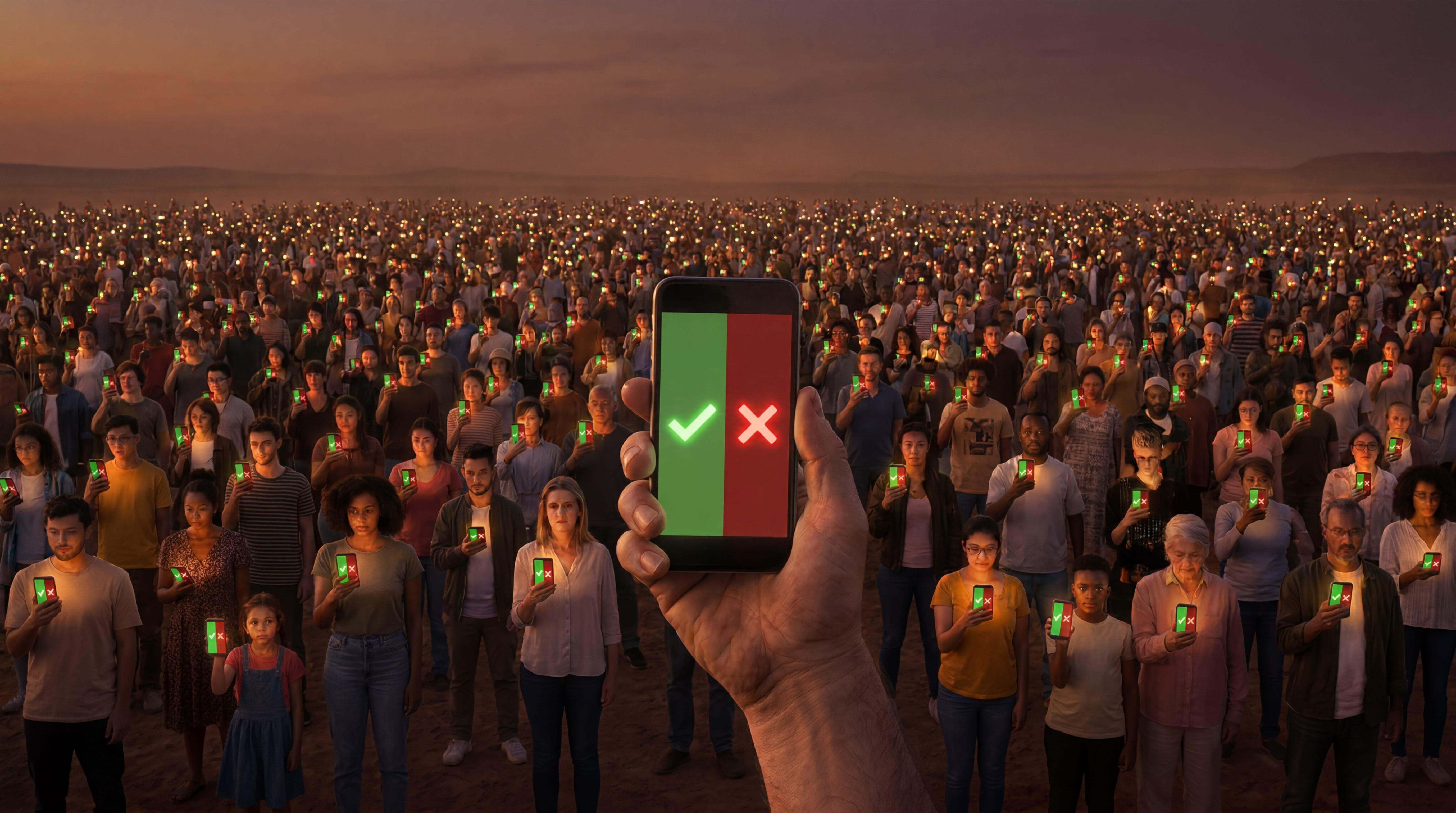
The fund rests on one promise, and every rule of its governance exists to keep it: every member counts exactly the same as every other. One person, one vote. The billionaire who sponsored a thousand memberships and the farmer whose dollar was paid for them by someone else hold precisely the same power over the fund — one vote each, one equal share each, not a fraction more for either.
This is the line the fund will not cross, because crossing it is how every institution like it has failed before. The moment money buys a larger say, the institution stops belonging to its people and starts belonging to its richest people — and from there it is only a matter of time before it serves them. The fund’s entire defense against that fate is a single, stubborn rule: financial weight and political weight are kept completely separate. You may give the fund more money. You may never buy more control with it.
Everyone votes — but a simple majority isn’t democracy
If every member gets one equal vote, an obvious problem appears immediately. The world’s population is not spread evenly. Asia alone holds well over half of humanity; two countries together hold roughly a third. If every fund decision were settled by a simple global head-count, then a small number of the most populous countries would decide everything for everyone else. The members in smaller countries would have a vote in name, but never enough to matter. That is not democracy. That is the large simply outvoting the small, forever.
So one-person-one-vote, by itself, is not enough. It protects against money buying power, but not against sheer numbers steamrolling everyone outside the biggest populations. The fund needs equality of persons and equality of nations at the same time — and that is why it is governed not by one vote but by two.
Two chambers, two kinds of fairness
Every major decision the fund makes must pass through two separate votes, each built on a different idea of what is fair.
The first is the Citizen Chamber. Here the whole membership votes as one body, one person one vote, every member equal regardless of country or how their contribution was paid. This chamber carries the fund’s founding moral truth: that every human being counts the same. It is the conscience of the institution — the voice that says no person anywhere is worth less than any other.
The second is the Country Chamber. Here each of the world’s countries — 194 in all — casts a single vote, and the direction of that vote is decided by the majority of that country’s own members — counted through the fund’s independent systems, beyond the reach of any government. A country of ten million and a country of a billion each cast one vote. This chamber carries a different truth: that no nation, however small, should be ruled by its larger neighbors simply because they have more people.
A proposal becomes a decision of the fund only if it passes both chambers. The two are designed to check each other. The Citizen Chamber stops a handful of small countries from imposing their will on the bulk of humanity. The Country Chamber stops the few most populous countries from imposing theirs on everyone else. Neither can act alone. Every real decision must satisfy both most people and most countries — two different majorities that each have to persuade the other before anything binds.
This is the heart of the fund’s governance, and it is worth seeing clearly: the protection against capture is not a clever rule that a clever enemy could rewrite. It is a structure. To capture the fund you would have to win two different elections, decided by two different majorities, at the same time — and the moment you tried, the AI that informs every member would teach all of them exactly what you were attempting. [Cross-ref: Article 4-2 — AI at Its Core.]
Why this lets ordinary people actually govern
A fair objection: most people are busy, and no one can become an expert on every decision a global fund faces — acquisitions, banking rules, industrial strategy, disputes. How can hundreds of millions of ordinary people truly govern something this complex?
The answer is the pairing of this voting structure with the fund’s information AI. Before any vote, every member can have the question explained to them in their own language, at whatever depth they want, with every side argued honestly and the strongest case against the fund’s own preference laid out plainly. The member does not need to already be an expert; they need to be informed, and the fund is built to inform them without telling them what to conclude. Equality of votes plus honest information is what turns “everyone has a vote” from a slogan into a government that actually works. [Cross-ref: Article 4-2 — AI at Its Core.]
The result is something genuinely new: a global institution where a person in a rural village and a person in a capital city participate on exactly equal terms, receive exactly equal dividends, and cast exactly equal votes — and where the machinery exists to make that equality real, not merely declared.
What can never be put to a vote at all
Finally, some things are placed beyond the reach of any vote, even a vote that passes both chambers. The most important promises the fund makes — that dividends are always shared equally, that the fund will never exceed its self-imposed ceiling in any industry, that the prices of essentials like food and medicine stay capped, that the governing AI stays open and auditable — are written into the fund’s constitution and protected by deliberately enormous majorities. A passing mood, a clever campaign, even a large majority in a single moment cannot undo them. The foundational rules exist precisely to protect the smallest and weakest members from any majority, however large — including a majority of members themselves on a bad day. A constitution that the daily vote could erase would protect no one.
That is the fund’s governance in one breath: every person equal, every country equal, two majorities required for anything to pass, the deepest promises locked beyond the reach of any vote, and an honest AI making every member’s vote an informed one. It is not a company with shareholders ranked by wealth. It is a democracy of equals, engineered so that it stays one.
The detail below is for readers who want the full machinery — how the chambers resolve a disagreement, what is locked in the constitution, and what the fund’s managers are and are not allowed to do.
The mechanics, in more detail
[For readers who want the full architecture. The locked design, in brief.]
When the two chambers disagree — a transparent, time-bounded cascade. Most disagreements are about degree, not direction, so the first stage resolves them quickly: over roughly two weeks, the AI governance layer analyzes where the chambers agreed and diverged and publishes a small set of compromise options — on the order of three alternatives — with full reasoning; both chambers vote again, and if any compromise carries both, it passes. If none does, a public deliberation period of about six weeks opens — the disagreement explained in plain language in every major language, minority positions given equal airtime, independent analysts publishing consequence assessments, members arguing it out in open forums — after which both chambers vote once more. If they still cannot agree, the proposal simply fails and cannot return for twelve months. This last rule is deliberate: the fund is obligated to act only with broad legitimacy, never to force a decision through. A proposal that cannot win both popular and country-level support should not pass, and “better to delay than to capture” is the governing instinct. The cooling-off period stops a determined faction from grinding the same fight over and over.
The AI’s role in governance — inform and tally, never decide. The governance AI does three things and only three: it translates each decision into plain, accessible language in any language; it presents the options without advocacy; and it collects and cryptographically verifies the votes at scale. It does not decide anything. The single structural risk — that whoever shapes the AI shapes the information — is answered by keeping it open-source with publicly auditable training data and a rotating technical oversight committee elected on fixed, non-renewable terms, so no individual or group ever holds that lever twice. [Cross-ref: Article 4-2 — AI at Its Core.]
That ordinary people can meaningfully decide complex governance questions through a digital platform is not just a hope — it has been demonstrated. In 2011 Iceland ran a crowdsourced constitutional process in which citizens participated directly in drafting fundamental governance decisions through digital tools, across geographic and demographic lines. That was a single nation with the technology of its day. The fund’s information layer does at global scale what Iceland proved was possible at the national one. [Source: Iceland 2011 crowdsourced constitution process.]
The constitutional layer — rules beyond any normal vote. Certain promises are foundational and cannot be changed by an ordinary majority: dividends always distributed strictly equally per member; no region favored in manufacturing allocation per person; the fund never exceeding its defined ownership ceiling in any industry; profit margins on essentials — food, medicine, water, housing — capped; the governance AI kept open and auditable. Changing any of these requires a global supermajority — three-quarters approval in both chambers at once, plus majority support in five of the world’s six continental regions — which makes them effectively permanent. They are the floor beneath the floor: the protections that no majority, however assembled, can take from the smallest members.
What management actually does. The people who run the fund execute the members’ mandates; they do not set them. Management discloses all financial information publicly and in real time, serves under fixed terms with recall votes and strict conflict-of-interest rules, and holds power that is operational, not directional. It carries out the agenda; it does not choose it. [Cross-ref: Article 4-2 — AI at Its Core; Article 4-3 — Members’ Engagement.]
Founding without founders. The people who design the fund in its planning years are constitutionally barred, for a long fixed period, from holding any operational role, sitting on any later transition body, or taking any compensation beyond their ordinary member dividend. They return to being ordinary members with one vote each and no special status. The fund does not have founders in any continuing sense; it has former designers who handed the institution to its members and stepped back. [Cross-ref: the build/transition phases are detailed in the Part on how the fund gets built.]
Join the conversation
This series belongs to everyone, including its critics. Tell us where you were convinced and where you were not — and if you see a way to make the proposal stronger, say so. You'll need a free account with a handle of your choosing.
Reset your password
Enter the email you signed up with. If it's registered, we'll send you a link to set a new password.
Be the first to comment.