

What Stops the Fund From Becoming What It Replaces
Article 7-1
What Stops the Fund From Becoming What It Replaces
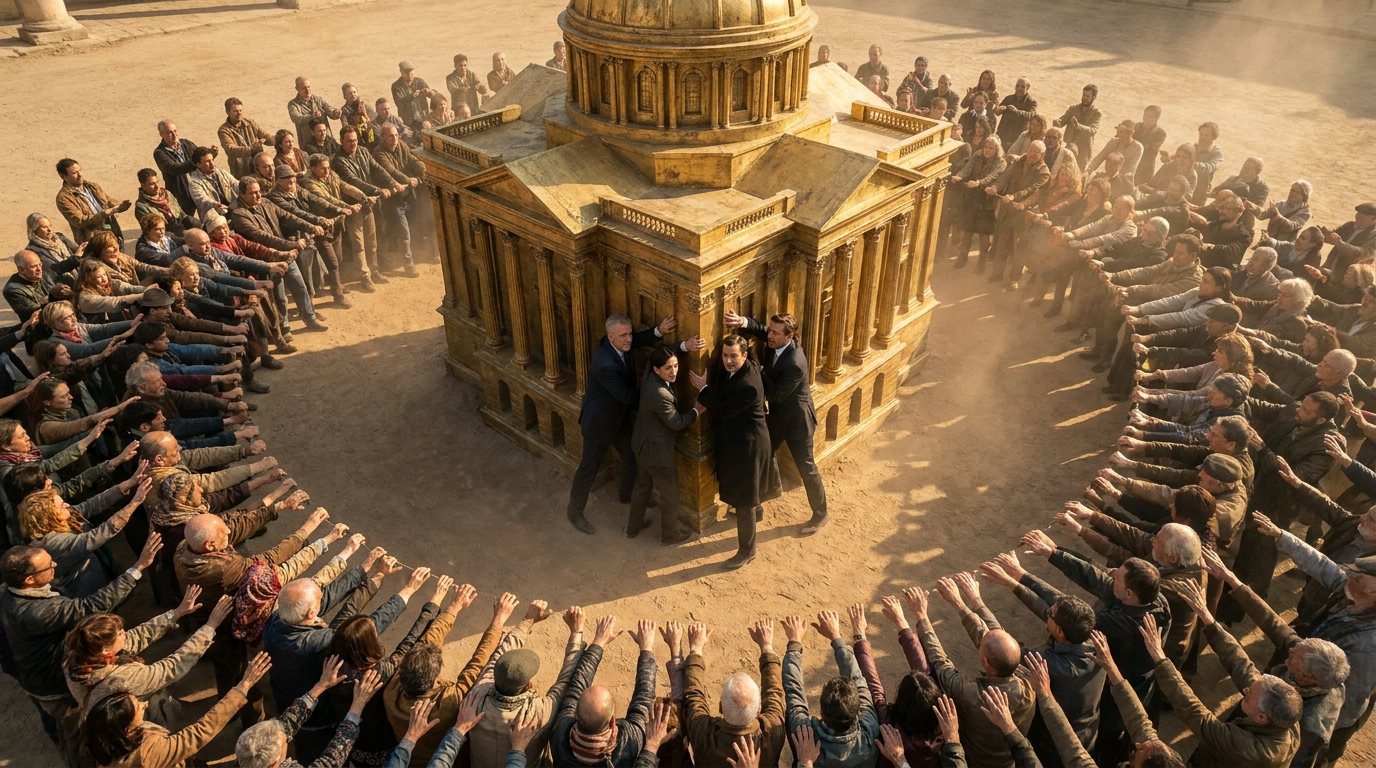
This is the article every thoughtful reader has been waiting for, because it answers the deepest skepticism the whole proposal generates. The case for the fund is structural — but so is the case against it. Every large institution in modern history that began with good intentions has, given enough decades, become something its founders would not recognize. Labor unions captured by professional leadership classes that grew more cautious than their own members. Cooperative movements that hardened into conventional businesses. Charitable foundations that became wealth-preservation vehicles for the families that created them. International institutions that became extensions of the most powerful states. Political parties that drifted from their founding purpose inside a single generation. The pattern is so consistent that institutional decay is, in effect, the default outcome for any organization that outlives its founders. Good intentions do not prevent it. Only structural design that anticipates specific failure modes might.
So before describing a single defense, this article must be honest about the two things that make the whole problem hard — because if those two are not faced first, every mechanism that follows is just machinery a captor can learn to operate.
The hardest truth, first: the protections could themselves become the capture
There is a paradox at the center of any anti-corruption design, and it is worth naming before anything else, because it is the trap that catches the cleverest institutions. The more comprehensive the fund’s defenses against corruption, the more those very defenses could become an instrument of control. A management team that wanted to entrench itself would not need to break the rules; it could hide behind them. “We cannot do what you are asking, because it would violate our governance framework” can become a shield against accountability rather than a tool for it. Anti-corruption language is exactly the language a sophisticated captor would learn to speak.
The fund’s answer to this paradox is a single, deliberate line drawn through everything that follows — between what is entrenched and what is not.
The fund’s foundational mission is entrenched: equal dividends per member, no region exceeding its proportional manufacturing share, the ownership ceiling in any single industry, the margin cap on essential goods, the open-source AI, the exclusion of weapons and speculation. These exist precisely to be unchangeable without extraordinary procedure, and a management team simply cannot circumvent them. That is their entire point. [Cross-ref: Article 4-1 — One Person, One Vote; Article 5-2 — What the Fund Owns, and How It Grows.]
The fund’s operational anti-corruption machinery — the term limits, the rotations, the audits, the disclosure rules, the conflict-of-interest provisions described later in this article — is deliberately not entrenched at that level. It is ordinary fund policy, revisable by the chambers through normal process. If members one day conclude a particular mechanism has stopped serving its purpose, they can change it. The protections are strong enough to constrain ordinary capture, but flexible enough to be reformed when members decide the design needs updating.
This distinction is the whole game. Entrenching every protection at the constitutional level would itself become a capture mechanism: a management team resisting member oversight could claim that any reform “violates the constitution,” turning the protections into a wall against accountability rather than a guarantee of it. So the fund entrenches the mission and leaves the machinery revisable, with members holding ultimate authority through ordinary chamber processes. Foundational character: fixed. Operational defense: robust but amendable. The people, not the machinery, hold the final say.
The deepest dependency: it only works if members keep watching
The second hard truth is even simpler, and no mechanism in this article can engineer around it. The biggest limit on any institutional design is the one thing design cannot reach: the engagement of members across generations. A captured but inattentive membership ratifies bad governance. A complacent membership fails to notice decay. Every protection described below works to the extent that members use it, and not one inch further.
This is the fund’s deepest dependency, and honesty requires putting it near the front rather than burying it at the end. The structural protections are strong; the requirement is that members care enough to reach for them. This is also the most insidious decay pattern of all — the one that has hollowed out nearly every democratic institution in the modern world. Labor unions watched active participation fall from majorities to single digits across the twentieth century. Political parties saw membership collapse from millions to thousands. Cooperative movements that began with engaged members became, over generations, institutions where most members never attended a meeting or voted on anything. The structures kept operating; the participatory base that was meant to control them thinned to nothing, and the institutions came to run effectively without the people they formally answered to.
The fund cannot abolish this risk. What it can do — and what its design is built around — is make engagement easy and meaningful enough that even casual, occasional participation by most members produces real accountability, rather than depending on deep involvement by a devoted few. [Cross-ref: Article 4-3 — Members’ Engagement.] The design optimizes for the light-touch participation real people actually offer. But it cannot force anyone to care. The honest statement of the fund’s deepest principle — that it is owned by everyone equally — comes with the honest statement of its deepest test: whether everyone equally cares enough to keep it alive.
With those two truths named, the rest of this article describes the machinery: the constitutional floor that cannot be moved, and the operational defenses against each documented way institutions rot. None of it depends on the fund’s leaders being unusually virtuous. All of it is designed to work even when leadership tries to evade it. But all of it sits on the two foundations just described, and a reader should keep them in view throughout.
The constitutional layer that cannot be moved
The fund’s constitution entrenches a small set of protections that define its fundamental character: equal dividends per member; no region exceeding its proportional manufacturing share per capita; the fund never exceeding its defined ownership ceiling in any single industry; profit margins capped on essential goods — food, medicine, water, housing; the AI governance system kept open-source with publicly auditable training data; participation banking with no interest-spread extraction; the exclusion of any profit from weapons or conflict; and the sponsorship fund’s self-extinguishing operation. [Cross-ref: Article 4-1 — One Person, One Vote; Article 4-2 — AI at Its Core; Article 5-1 — How the Money Flows; Article 5-2 — What the Fund Owns, and How It Grows.]
Changing any of them requires the supermajority described in the governance article — three-quarters approval in both the Citizen Chamber and the Country Chamber at once, plus majority support in five of the six continental regions. [Cross-ref: Article 4-1 — One Person, One Vote.] The threshold is intentionally extreme. It is not the bar for ordinary fund decisions; it is the bar for altering the fund’s fundamental character, and a management team that wanted to compromise these protections would have to clear it in full public view, through visible chamber processes members can watch and resist.
These protections are necessary but not sufficient. They make certain forms of capture structurally impossible to enact — but they do not, by themselves, address every way an institution decays. Operational anti-corruption is its own design problem, and the rest of this article addresses it, one documented failure mode at a time.
The operational defenses, by failure mode
What follows are the six operational patterns by which real institutions have been captured, and the specific mechanisms the fund uses against each. The examples are real; the mechanisms are specific; none assume virtue.
Management capture — when the people running an institution come to identify with their own positions and the institution’s survival rather than its mission. The AFL-CIO’s professional leadership class, by the late twentieth century, had grown more cautious on labor matters than the members it represented. Foundation boards across the sector repeatedly transformed from vehicles for their founders’ radical purposes into conservative trustees of their founders’ fortunes. The IMF developed a culture in which staff careers and institutional reputation took precedence over the developmental mission. The pattern is not about corrupt individuals; it is about how institutional incentives reshape any leadership over time. The fund answers it with six mechanisms: defined term limits with mandatory rotation (chief executive five years maximum, no extension; regional directors four; department heads five; country bank managers four — after which the authority of that position rotates to someone else); member-initiated performance removal (a petition from a set percentage of the relevant constituency — five percent of Citizen Chamber members for the chief executive, ten percent of regional members for regional directors — triggers oversight investigation and a chamber vote); fully transparent compensation, published as specific amounts annually for every senior position, because members pay those salaries from their own contributions and dividends; strict conflict-of-interest enforcement (no other paid position, no gifts or hospitality from interested parties, no trading in companies the fund might touch, continuous public disclosure during service and for five years after, with violations bringing immediate removal and a lifetime ban); post-service employment restrictions (no working for an acquired company, a major competitor, or a business partner of the fund for five years after leaving, to kill the revolving door); and operational separation between fund management and fund-aligned organizations, so no informal network of leadership forms outside the formal accountability structures.
Resource capture — when a subset of members, donors, or partners gains disproportionate influence over the institution’s resources, and the institution begins serving them at the expense of its broader mission. Foundations drift toward serving their largest donors; cooperative banks gradually favor their biggest depositors; unions pour resources into already-organized industries while neglecting the unorganized. The fund answers with four mechanisms: the constitutional equality of dividends (every member receives the identical dividend regardless of how much they contributed — a wealthy member’s pre-paid lifetime contribution generates exactly the same dividend as a low-income member whose dollar is covered by the sponsorship fund, with no exceptions and no carve-outs); a prohibition on differentiated service for larger contributors (identical service, access, and dispute priority for everyone — the fund is structurally a one-class institution, and service metrics are tracked and disclosed to catch any drift toward tiered treatment); public disclosure of every interaction between fund operations and external parties (every meeting with any government, company, or lobbyist logged with date, participants, and subject, and published quarterly, so invisible influence becomes visible and auditable); and the same structural separation between fund leadership and outside organizations described above.
Mission drift — when the stated mission stays formally unchanged but operational priorities quietly shift toward what is easy or profitable and away from what is hard or unprofitable, until an institution ends up doing the opposite of its founding purpose while still flying its founding banner. The Ford Foundation is the documented case: founded in 1936, genuinely progressive in its early decades — civil rights, international development, controversial social research — it drifted across the second half of the century toward safer, more conventional philanthropy, the operational drift visible long before any formal change of mission. The fund answers with five mechanisms: explicit operational metrics tied to mission (dividends per member by country and globally, manufacturing employment formalized by region, essential-goods prices in fund-served markets, workers under fund-improved standards, healthcare costs, ownership concentration in the fund’s industries — all published quarterly, so drift becomes visible as a trend); a mandatory five-year strategic review by the chambers that cannot be skipped or postponed, testing whether actual operations still match the stated mission; constitutional protection against expansion into the excluded categories (defense, speculative finance, the stock exchange itself, raw-material extraction — entrenched behind the supermajority, so the most dangerous drift, into profitable-but-off-mission industries, is blocked even if a future management and majority would prefer it); mandatory waiting periods for any change to core operational approach, making quick unscrutinized changes structurally impossible; and continuous public reporting on what the fund actually does versus what it says it does, produced internally and audited externally, including honest acknowledgment of decisions that may have moved away from mission.
Verification failure — when accountability becomes procedural rather than substantive: audits technically independent but practically captured, disclosures technically complete but practically opaque, members with rights on paper and no effective way to use them. The IMF is the documented case — formal accountability mechanisms that operated throughout its history but rarely produced substantive correction of its most contested actions, because the structural relationships made formal accountability toothless against the professional consensus of staff and the most powerful member states. The fund answers with six mechanisms: auditor rotation and independence (external auditor changes every five years, ten years maximum, selected by the chambers rather than management, barred from also selling consulting services); multiple parallel audit streams (a financial auditor, an operational auditor, and a specialized AI-ethics auditor reviewing the open-source systems for bias and alignment — each producing its own report, with discrepancies triggering investigation, so capturing one auditor gains a captor little); member access to raw data (the underlying financial, operational, and decision data through a transparency portal, not pre-digested into management’s narrative, so members can analyze it themselves); AI-assisted independent analysis (any member who suspects something can ask the AI to investigate using the same data the official auditors use, turning oversight from a purely top-down function into a distributed one); structural whistleblower protections (reports reviewed by the oversight body rather than management, retaliation grounds for immediate removal and lifetime ban, protections enforceable in ordinary courts); and a bar on auditors taking fund employment for seven years after their engagement, to prevent favorable opinions traded for future jobs.
Talent corruption — when the executives and specialists an institution needs are drawn from a market where private roles pay far more, so the institution either fails to attract good people or compromises its principles to get them, and the compromises accumulate. Europe’s largest cooperative banks are the documented case: over decades their treatment of senior management — compensation, executive culture, distance from members — converged on conventional commercial banking even as the cooperative form stayed formally intact. The fund answers with five mechanisms: market-competitive cash compensation, deliberately stripped of the extraction-incentivizing components (no large short-term stock options, no deal-volume bonuses, no severance that rewards departure) that captured private-sector executive culture; royalty-based compensation that ties reward to durable long-term value (scientists, designers, architects earning royalties that last as long as the value does, aligning pay with outcomes rather than quick wins) but cannot be detached from the value it compensates; restrictions on outside positions (full professional dedication during service, no outside boards or businesses — more restrictive than most institutions, costing the fund some talent, a cost it accepts for aligned incentives); transparent compensation disclosure for every senior position, including structure, benefits, and any payments to family through fund entities; and a cultural framing that treats mission-aligned work as part of the compensation, shaping who applies and what they expect.
Institutional inertia — when an institution becomes excellent at what it has always done and progressively worse at adapting, failing not through corruption but through inability to change. Many religious denominations are the documented case: technically functional, progressively less able to adapt to changing social context. The fund answers with four mechanisms: a constitutional, unreducible innovation budget (a defined percentage of operating budget reserved for new technology, operational experiments, and market entries, which management cannot cut); scheduled review dates for every operational approach, so none persists indefinitely without scrutiny; willingness to spin off or close fund operations that no longer serve members, through a structured process — the fund does not treat its own operations as ends in themselves; and technological openness rather than proprietary capture (open-source systems, auditable code, standard data formats, so the fund never becomes dependent on proprietary systems it controls but members cannot inspect).
What members can actually do when something goes wrong
All of this machinery exists to be used, and the path from noticing a problem to fixing it is built as a series of escalating steps any member can begin.
A member who sees something wrong can investigate it through the AI engagement system, pulling the fund’s own data and producing an independent analysis. [Cross-ref: Article 4-2 — AI at Its Core.] That analysis can be shared through the regional and local structures to build a coalition of concerned members. A coalition can submit a formal proposal to the chambers — for investigation, for policy change, for personnel action — and the chambers must take up properly submitted proposals through defined processes. A coalition can initiate a petition to remove a specific official, triggering oversight investigation and a chamber vote. A coalition can initiate a constitutional-change proposal for structural problems ordinary action cannot reach, facing the deliberately high supermajority. And in the most extreme case, members retain the right to dissolve the fund entirely — to conclude it has become unfit and cannot be corrected, and to wind it down and distribute its assets equally, under the same supermajority as constitutional change, with an eighteen-month waiting period for reconsideration.
That dissolution right is the ultimate protection, and it works in a subtle way: it makes the fund’s continued existence conditional on its continued service to members. A management team that captured the fund against its members would face the prospect that members might simply end it rather than tolerate the capture — which makes capture itself less attractive, because an institution that can be ended by its own members is worth far less as a prize than one whose survival is guaranteed.
The honest limits of any design
No design is perfect, and it would betray the rest of this series to pretend otherwise. The mechanisms here will not prevent every form of decay; they will make many forms structurally difficult while leaving others available. Some failures will happen. Some abuses will go undetected. Some decay will accumulate slowly enough that no single moment of correction is ever triggered.
What the design does is shift the burden: from “decay is the default” to “decay requires sustained effort against structural protections.” That shift is not absolute, but it is real, and it is the most any institutional design can honestly promise. The fund will also face challenges across decades that no one writing today can anticipate — technological changes that reshape what it can do, geopolitical shifts that alter specific countries’ relationships with it, social changes in what membership even means. It will meet them as itself: through its members, its operating team, and its constitutional structure. The design described here is a starting point, not a finished state; the institution that actually exists decades from now will reflect everything it has been through, some changes improvements and some regressions. The protection is not that the fund never changes. The protection is that it changes with member knowledge and member consent, never through unilateral management action in the dark.
If the process succeeds, the institution that emerges will be the largest example in human history of citizens organizing economic activity at global scale to serve their own collective interest. Every structural protection in this article exists to keep that example alive and on-mission for the generations who arrive after the founders are gone. Whether they succeed will, in the end, come down to the two truths this article began with: that the protections must never harden into a wall against the members they serve, and that the members must care enough to use them. The fund’s deepest principle is that it is owned by everyone equally. The deepest test of that principle is whether everyone equally cares enough to keep it so.
Join the conversation
This series belongs to everyone, including its critics. Tell us where you were convinced and where you were not — and if you see a way to make the proposal stronger, say so. You'll need a free account with a handle of your choosing.
Reset your password
Enter the email you signed up with. If it's registered, we'll send you a link to set a new password.
Be the first to comment.