

Why Empires Corrupt Everything
Article 1-2
Why Empires Corrupt Everything
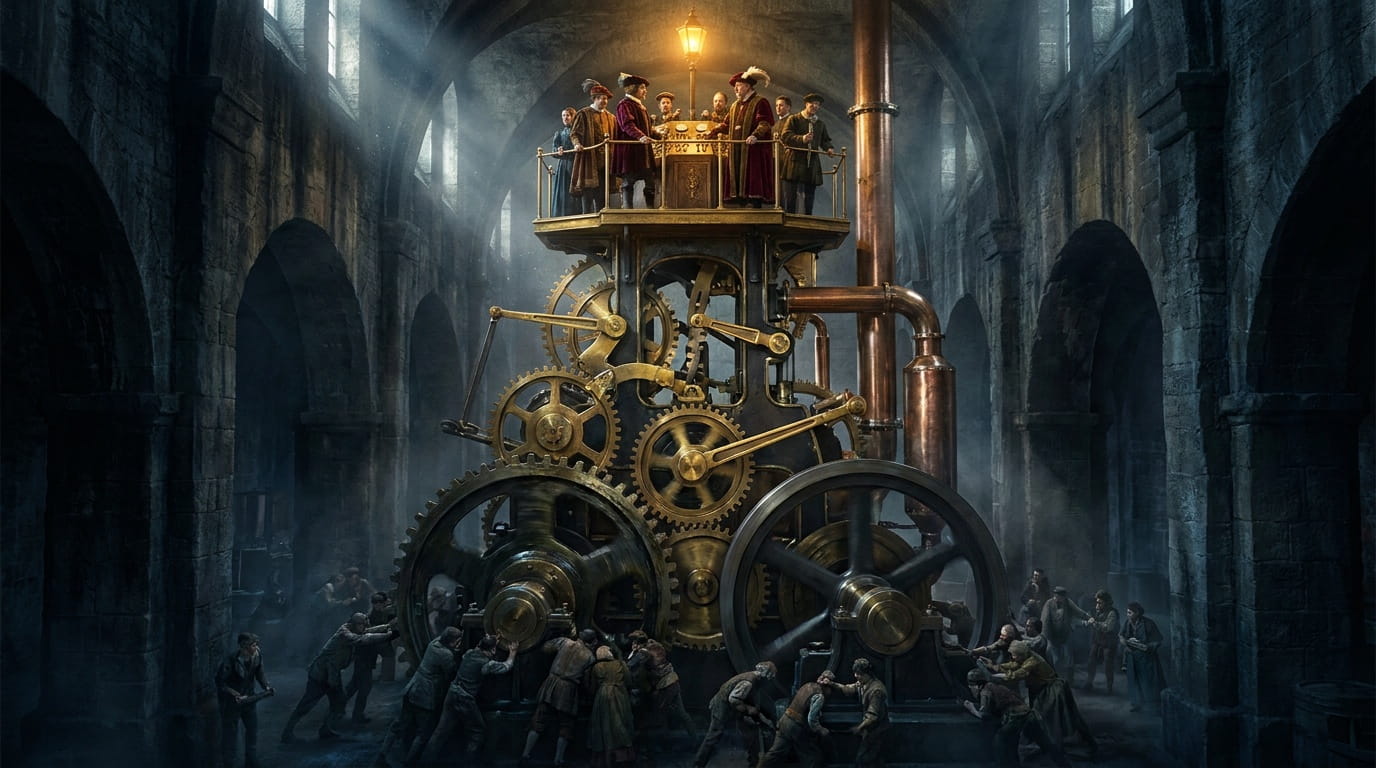
In 1887, Lord Acton wrote a sentence that has survived every attempt to disprove it: “Power tends to corrupt, and absolute power corrupts absolutely.” Nearly a hundred and forty years later, no one has found the exception. The reason it endures is that it describes not a flaw in particular rulers but a pattern in power itself — a pattern older than nations, and visible wherever enough of it accumulates in too few hands.
The pattern runs like this. A group gathers enough resources to influence outcomes. That influence lets it gather still more resources. Those resources then buy protection for the very rules that allowed the gathering in the first place. The loop closes, and an empire forms — not always one with flags and armies, but always with the same architecture underneath: a small group extracting value from everyone else, powerful enough to make the extraction look like the natural order of things. This article is about that architecture, why it corrupts whatever it touches, and why the corruption does not depend on whether the empire flies a corporate logo or a national flag.
Today’s empires rarely call themselves empires. They call themselves corporations, conglomerates, investment funds, and sovereign portfolios. But Acton’s logic does not care what an empire is named. It cares only that power has concentrated — and once it has, the corruption follows the same course it always has.
How concentrated wealth captures democracy
Begin where the power is densest. A small number of asset-management firms now sit atop an astonishing share of the corporate world. The three largest — BlackRock, Vanguard, and State Street — together manage more than twenty-five trillion dollars, and together they are the single largest shareholder in roughly nine of every ten companies in the S&P 500, and in more than forty percent of all publicly traded American firms. [Source: Costello College of Business / company reports, 2025.] Three companies, the largest owner of nearly everything.
Acton predicted what that does. When the same few owners hold large stakes in every competitor in an industry at once — every major airline, every major bank — none of those owners has any reason to want the competitors to truly fight one another, since they profit from all of them. Economists have a polite name for the worry, “common ownership,” and a blunt description of its effect: a shareholder who owns all the airlines has little reason to push any one of them toward the aggressive competition that would lower prices for passengers. [Source: IBF Financial Knowledge Center, 2026.] Competition is the one force that disciplines corporate power, and concentrated ownership quietly dulls it.
The same concentrated wealth then reaches into politics, because Acton’s loop requires it to. Wealth that large cannot afford to leave the rules to chance, so it funds political careers, deploys armies of lobbyists, and shapes the laws and regulators that are supposed to constrain it. We saw the scale of this in the previous article: the very rich are thousands of times more likely than ordinary citizens to hold political office, and they own most of the largest media companies and essentially all the major social platforms through which a society sees itself. [Cross-ref: Article 1-1 — Current Political Dynamics.] A democracy can hold elections as often as it likes; if one small group owns the economy, funds the candidates, and controls what voters see, the outcome was shaped long before any vote was cast. The ballot remains; the power behind it has moved elsewhere.
How empires reach across borders
Acton’s pattern does not stop at a nation’s edge. An empire large enough to capture its own government is large enough to reach into weaker ones, and it does.
A global corporation that has outgrown the leverage of any single state can play nations against each other — extracting tax holidays, lax regulation, and cheap labor by threatening to take its factories and its investment elsewhere. It can secure favorable terms for the raw materials it needs from countries too weak to refuse.
This is not a figure of speech, and the numbers are large. Each year, multinational corporations shift on the order of a trillion dollars in profits into tax havens, depriving governments around the world of more than two hundred billion dollars in tax revenue; developing countries, which depend most heavily on corporate taxes, are estimated to lose somewhere between one hundred and two hundred forty billion dollars a year this way. [Source: ICIJ / International Centre for Tax and Development; Carnegie Endowment, 2024-2025.] And lest this read as an accusation against one country, the firms shifting profits most aggressively are headquartered in rivals scattered across the map — among them the United States, Brazil, and Singapore — which is precisely the point: the behavior follows concentrated corporate power, not any single flag. [Source: García Bernardo & Janský, ICTD, 2024.] The extraction is just as visible in the ground itself: in one documented case, five companies producing roughly four billion dollars of Zambian copper paid the government only about three hundred ten million dollars in tax. [Source: The Conversation / War on Want, 2025.]
When ordinary commercial pressure is not enough, harder instruments have always been available to empires: economic coercion, political destabilization, the quiet support of a friendlier government, and — in the oldest pattern of all — the occasional war fought for markets and resources while described as something nobler. The countries on the receiving end experience this not as abstract economics but as poverty that does not lift, governments that answer to outsiders, and wealth that flows out faster than it comes in. Acton’s corruption, exported.
The Middle East is the clearest century-long case of this pattern at work. Once oil became the strategic prize of the industrial age in the early 1900s, outside powers redrew the entire region around it: as the Ottoman Empire fell, Britain and France secretly divided its Arab lands between themselves in the 1916 Sykes-Picot Agreement, breaking their own promises of Arab independence and inventing new states whose borders were moved to keep the oil on the favored side. [Source: Britannica; Sykes-Picot Agreement, 1916.] The method did not retire with the colonial era. In 1953, when Iran’s elected government nationalized its own oil, Britain and the United States overthrew it in a coup the CIA later admitted organizing, restored a compliant shah, and handed Western companies control of roughly forty percent of Iranian oil. [Source: Britannica; CIA declassified records, 2013.] The same logic — secure the resource, install or protect a friendly ruler, override the self-determination of the people who live there — has repeated across the region for a hundred years, and the resistance movements it provokes are the predictable equal-and-opposite reaction to it: another concentration of power, formed in answer to the first. None of this requires a conspiracy theory. It only requires noticing who kept the oil and who never got the say.
The lever is not always a coup; sometimes it is simply money in a democracy. In the United States, organized lobbies spend heavily to align lawmakers with their cause, and pro-Israel groups such as AIPAC are among the most effective, funding and opposing candidates to keep American policy firmly behind the Israeli government. [Source: campaign-finance records, widely documented.] The cost of that alignment can be measured in what it overrides: the United States has repeatedly used its UN Security Council veto to block action on Palestinian statehood and on Israeli conduct, even as the International Court of Justice ruled in 2024 that it is plausible Israel is committing genocide in Gaza and ordered emergency measures to prevent it — a finding that stops short of a verdict but grave enough that the Court’s own judges thought the risk real. [Source: ICJ provisional measures, January 2024.] When concentrated private influence can keep a government defending another state through a charge that serious, the loop Acton described has closed once more: economic and political power shielding one another, with the people on the ground — Palestinian and Israeli alike — left to pay for decisions made far above them.
Why this is not an argument against business
It would be a serious misreading to take any of this as hostility toward business, trade, or profit, and the distinction is worth stating plainly before going further.
Business is not the disease. Companies that make genuinely good products, compete honestly, pay fairly, and earn a reasonable profit are among the most useful inventions in human history. Markets that actually function — where many sellers compete and no single one can dictate terms — produce abundance that no central planner has ever matched. The argument here is not against enterprise; it is against empire, which is the precise opposite of a functioning market. An empire is what forms when one player grows powerful enough to stop competing and start dictating — to swallow its rivals, capture its regulators, and convert a market into a private domain. The problem was never that people sell things to one another. The problem is concentration: the point at which an actor becomes too powerful to be checked by competition, law, or democratic will. Acton’s warning is not about commerce. It is about power that has escaped accountability.
The mirror image: when the state becomes the empire
And here is the part that completes the argument, the claim the opening article promised to make good on. If the disease is concentration rather than any particular owner, then handing all economic power to the state cures nothing — because it is the same disease wearing a different coat.
This is why the proposal of this series is not, and never will be, communism. Concentrating an entire economy in the hands of the state places exactly the kind of absolute power Acton warned of in exactly the few hands he warned about — only now they are the officials of one party in one capital rather than the shareholders of a few funds in a few financial centers. The loop runs identically. The state-as-empire gathers resources, uses them to entrench its own rule, and protects the arrangement with whatever instruments it can reach: censorship, surveillance, the security services, the courts.
And a powerful state reaches across borders exactly as a powerful corporation does, using whatever lever it holds. One lever is debt. Where state lenders have financed large projects in poorer countries, some of those countries have ended up dependent and have handed over strategic assets when the debts grew unpayable: Sri Lanka leased its Hambantota port to a Chinese state firm on a ninety-nine-year lease, and Laos ceded control of its national electricity grid to a Chinese state company after its energy debts mounted. [Source: Lowy Institute, 2025.] Scholars genuinely disagree over whether this dependency is deliberate strategy or the by-product of overreach and weak contracts, and that debate is worth respecting — but the outcome is not in dispute: nations lost control of critical infrastructure to a foreign state. Another lever is supply. Russia spent years using its position as an energy supplier to pressure and punish neighboring states, throttling or cutting gas to extract political compliance — the same coercion by dependency, run through a pipeline instead of a loan. [Source: widely documented, 2006-2022.] Different capitals, rival powers, the same architecture: a concentrated state turning others’ need into leverage over them.
History has run this experiment repeatedly, and the result is grimly consistent — the promised equality arrives as a new ruling class, and the ordinary person is left as powerless before the state as they once were before the oligarch. Absolute power corrupted absolutely, exactly as predicted, regardless of the flag it flew.
So both of the answers the twentieth century fought over turn out to fail Acton’s test in the same way. Unchecked private capital concentrates power in a wealthy few. Unchecked state control concentrates it in a political few. Each calls the other the enemy; each is, in the end, the same architecture of extraction with a different group at the top. The choice between them is not a real choice. It is a choice of which empire you would prefer to be ruled by.
The way out cannot be another concentration. It has to be the opposite — power spread so widely, owned by so many, and bound by such deliberate limits that no group, public or private, can ever gather enough of it to escape accountability. Acton diagnosed the disease more than a century ago. The rest of this series is an attempt to design, seriously and in detail, an institution that does not catch it.
Join the conversation
This series belongs to everyone, including its critics. Tell us where you were convinced and where you were not — and if you see a way to make the proposal stronger, say so. You'll need a free account with a handle of your choosing.
Reset your password
Enter the email you signed up with. If it's registered, we'll send you a link to set a new password.
Be the first to comment.