

The Other Empire
Article 1-3
The Other Empire
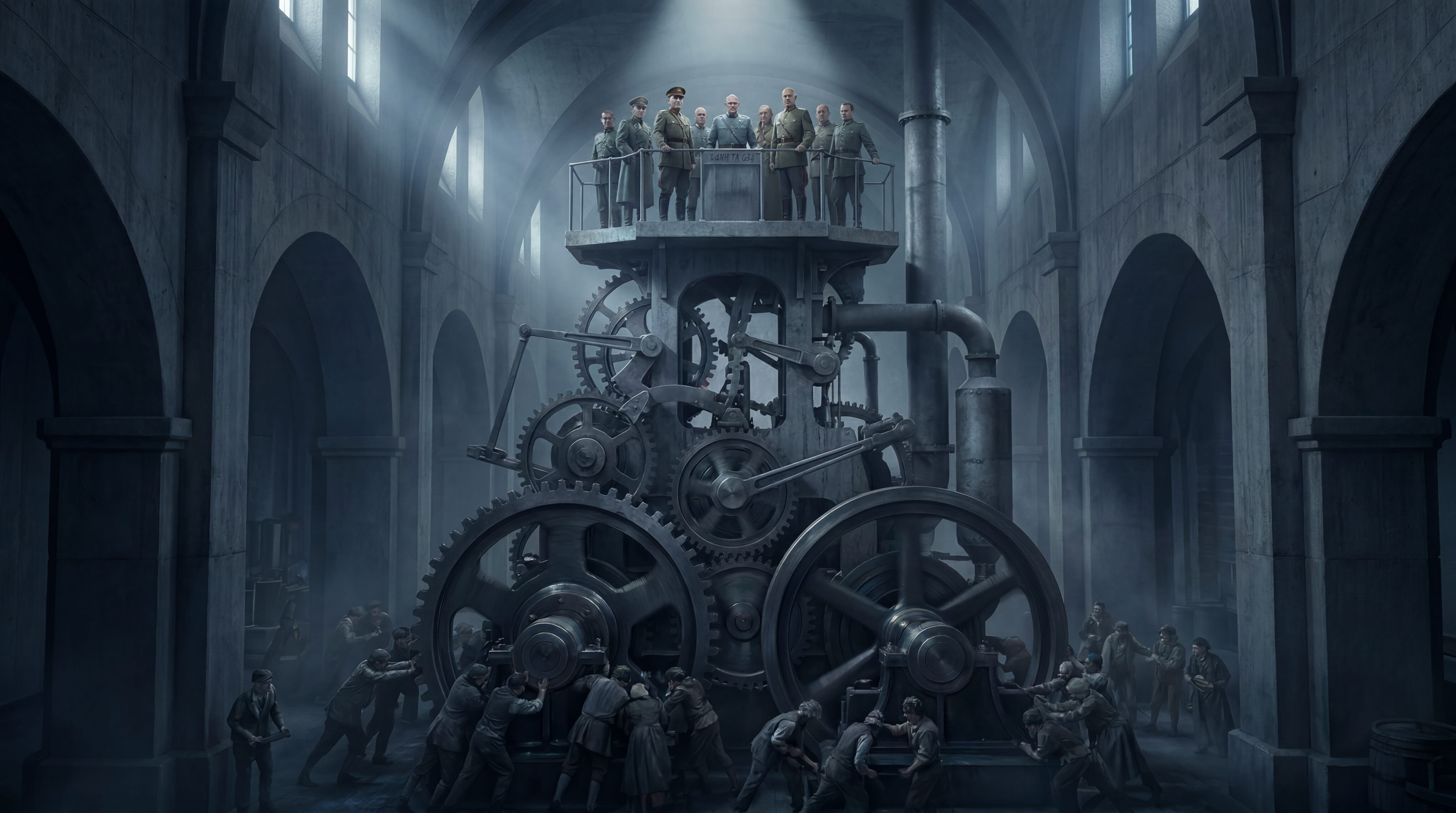
Any proposal to spread economic power more widely will be accused, by those who prefer it concentrated, of being its opposite: a scheme to hand the whole economy to the state. So this article meets that accusation head-on. The previous article argued that concentration corrupts whoever holds it, in principle. This one shows what that looks like in practice when the concentrating hand is a government rather than a corporation — because the failure is just as real, just as documented, and just as costly to ordinary people. The fund is not communism, and the clearest way to prove it is to be honest about how state-concentrated economies actually fail.
They fail through a specific mechanism, and once it is named it becomes easy to recognize. When a state seizes control of the economy and crowds out private enterprise, the productive economy shrinks. Output falls, tax revenue dries up, and foreign investment flees. But the regime still has bills to pay — security forces, subsidies, the machinery of control — so it reaches for whatever funding it can find. And what it finds, with grim regularity, is something illicit: foreign patrons, smuggling, sanctioned trade, or partnership with criminal networks. The state does not always become the criminal economy, but it ends up entangled with one. The pattern is clearest if we start with the state where it originated, and then follow it into three smaller economies that tried the same model and had nowhere to hide from the bill.
The Soviet Union: where the pattern begins
The clearest place to start is the state every later example descends from, because it shows the mechanism in its purest form. Concentrating an entire economy in a single party that answers to no one — no opposition, no independent press, no market and no vote that can overrule it — does not spread the wealth it seizes. It redirects it. The Party and the nomenklatura around it lived with a security the ordinary citizen never saw: special stores, reserved housing, foreign goods, and protection from the scarcity that defined everyone else’s life. Below that circle, the people absorbed the costs — because no one could contradict the Party, its mistakes compounded for years instead of being corrected; because the regime’s survival came first, resources flowed to the military and the security apparatus while the country holding some of the planet’s richest farmland became a chronic grain importer and consumer goods stayed perpetually scarce. [Source: widely documented; CIA and academic estimates of late-Soviet economic decline, 1980s-1991.] A system accountable only to itself can sustain that imbalance for a long time, but not forever: in 1991 the union collapsed, bankrupted from within by the very concentration that was meant to make it strong. It was large enough to carry the contradiction for seventy years and even to fund others who promised to copy it. The states that tried the same model at a smaller scale had no such room — and the first of them appears next.
Cuba: survival on someone else’s money
For three decades, revolutionary Cuba was kept solvent not by its own production but by a foreign patron. Soviet subsidies ran to roughly four billion dollars a year in the late 1980s — on the order of a fifth of Cuban economic output — and part of that money funded armed left-wing movements across Latin America through a dedicated state apparatus. [Source: Cuba Platform; E.I.A.L. Vol. 28, 2017.] When the Soviet Union collapsed, the subsidy vanished, and Cuba fell into a decade of severe crisis — the “Special Period” of the 1990s — surviving on tourism and a patchwork of foreign investment until, from around 2000, it was rescued again by cheap Venezuelan oil, trading the security and medical services it could offer for the energy it could not produce. A government that promised to free the poor of a continent could not, in the end, feed its own people without a benefactor. Through every phase, the leadership and its security apparatus kept their position; it was the population that queued for rationed food and lived the blackouts of the Special Period. The dependence was not a detour from the model; it was the model’s only way to survive.
Venezuela: from nationalization to the shadow economy
Venezuela ran the experiment in the open. It nationalized industries, dismantled independent institutions, and watched its once-rich productive economy collapse. As legitimate revenue disappeared and sanctions tightened, the state leaned increasingly on what remained available outside the rules: oil sold around the sanctions, gold pulled from poorly governed mines, and working arrangements with armed groups along the Colombian border that trade in both. [Source: widely documented, 2019-2025.] The promised workers’ paradise became one of the largest refugee crises in the hemisphere, with millions leaving to find food and work elsewhere. The officers and officials who controlled the rackets grew rich on what was left, while it was ordinary Venezuelans who fled. Concentration did not deliver equality; it delivered collapse, and then dependence on the shadow economy to paper over the collapse.
North Korea: a state that runs on crime
Lest this seem a peculiarly Latin American story, look to the opposite side of the world. North Korea is perhaps the purest modern case of a state-concentrated economy that, having strangled its own productive capacity, sustains itself through systematic illegality. Cut off from legitimate trade, the regime has turned crime into statecraft: state-directed cyber-theft of cryptocurrency and bank funds, counterfeiting, weapons sales, and sanctioned-goods smuggling, run as official programs to fund the government and its weapons. [Source: UN Panel of Experts; widely documented, 2023-2025.] The proceeds sustain the ruling family, the army, and the loyal elite of the capital, while beyond it the population has lived through famine. A country whose founding promise was self-reliance now finances itself by stealing from the rest of the world — the same mechanism as Cuba’s patrons and Venezuela’s shadow trade, simply taken to its logical extreme. The flag is different and the ideology is local, but the architecture is identical.
The same disease, the other costume
Put the four together and the lesson is the one the previous article predicted. Concentrating economic power in the state does not escape the corruption of concentrated power; it reproduces it exactly. In each case the same two things are true at once: the party and the circle around it are protected and provided for, while the general population absorbs the shortages, the inflation, and the collapse. What differs is only how the regime funds that arrangement once it has destroyed the productive economy that might have paid for it honestly — and that turns out to be a question of scale. The Soviet Union was large enough to carry the contradiction for decades and even to bankroll others, until it finally collapsed under its own weight. The smaller imitators had no such margin: once sanctions closed the legitimate options, Cuba survived on a patron, Venezuela on the shadow economy, North Korea on state-run crime. The specific costume varies — Soviet subsidies, sanctioned oil, industrial-scale cyber-theft — but underneath is the same body: a small group holding power it cannot be held accountable for, living well off prosperity it failed to create while the people below it pay the price.
This is why the answer to corporate empire cannot be state empire. They are two forms of the one disease that this entire series is written against: the concentration of power beyond the reach of the people it rules. The fund rejects both. Its whole design is the refusal to let economic power gather in any single set of hands — private or public — because history is unambiguous that wherever it gathers, in whatever name, it corrupts, and the people end up paying for it. [Cross-ref: Article 1-2 — Why Empires Corrupt Everything.]
Join the conversation
This series belongs to everyone, including its critics. Tell us where you were convinced and where you were not — and if you see a way to make the proposal stronger, say so. You'll need a free account with a handle of your choosing.
Reset your password
Enter the email you signed up with. If it's registered, we'll send you a link to set a new password.
Be the first to comment.