

Current Political Dynamics
Article 1-1
Current Political Dynamics
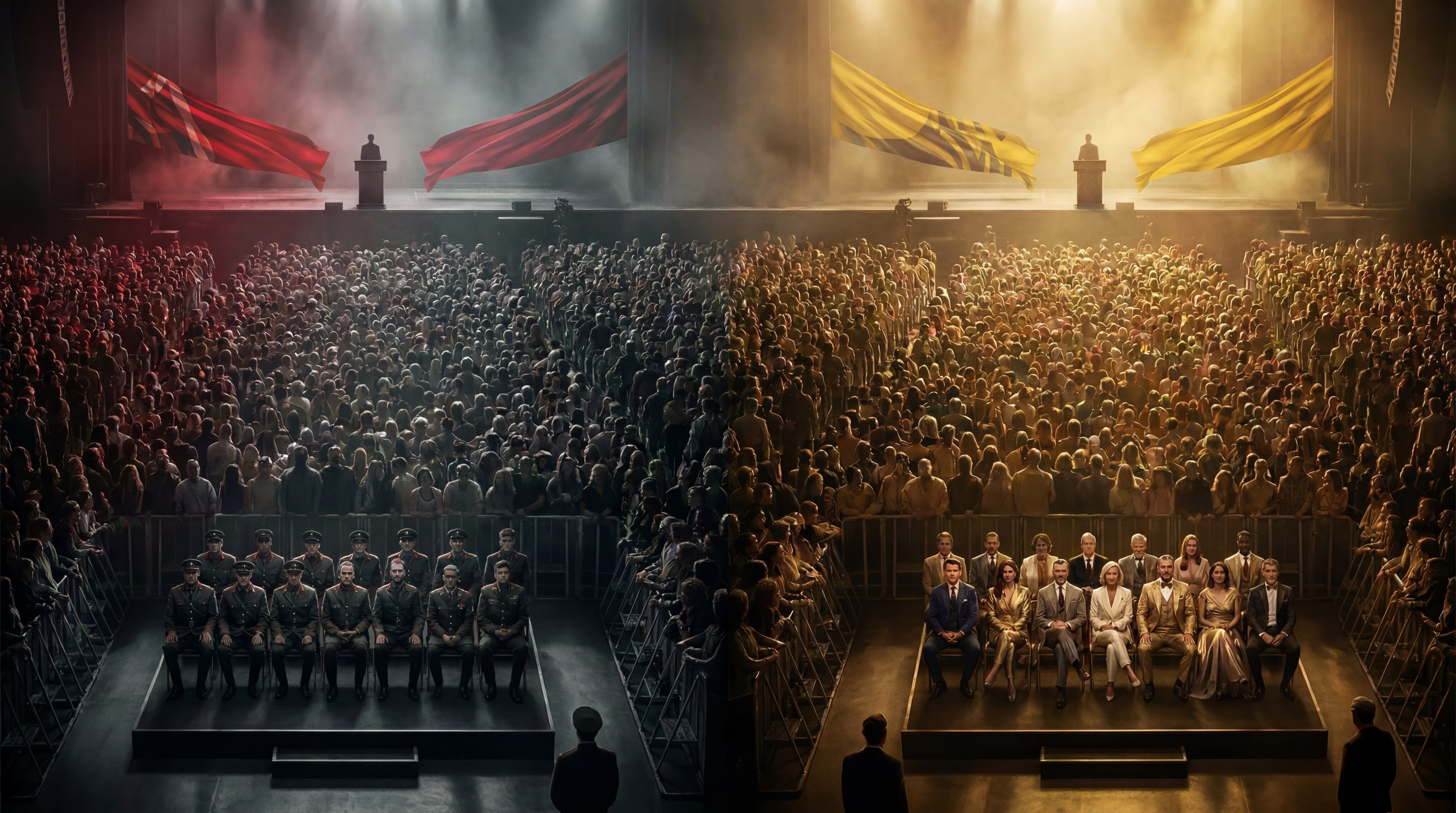
Something is broken in the world, and most people can feel it even when they cannot name it. People work harder and fall further behind. Wealth piles up faster than ever, in fewer and fewer hands. Citizens vote in democracies whose governments somehow keep serving someone other than the people who elected them. The sense that the rules are rigged is not paranoia, and it is not new — but it has rarely been as measurable as it is right now.
Consider where the world actually stood at the start of 2026. The total wealth of the world’s billionaires had reached about 18.3 trillion dollars — a record — having grown roughly 81 percent since 2020 and, in 2025 alone, three times faster than its own average over the previous five years. The world’s twelve richest people now hold more wealth than the poorest half of humanity combined: more than four billion human beings. [Source: Oxfam, Resisting the Rule of the Rich, January 2026.] This is not the natural weather of an economy. It is the predictable output of a particular machine.
A system working exactly as designed
The most important thing to understand about this is that it is not an accident or a malfunction. A system that reliably produces the same result, decade after decade, is not failing — it is working as designed, for the people who designed it. The machinery of the global economy concentrates wealth because it was built by and for the people who benefit from concentration, and it will keep doing so until a new player enters the game.
Follow the logic and it is not even mysterious. A very small number of people — call them, as the world does, the billionaires — draw most of their wealth from large global companies. The more those companies expand, the more they cut their costs, and the more they eliminate their competition, the richer that small group becomes. So the incentive is permanent and obvious: grow without limit, pay as little as possible, and crush or absorb anything that competes. And because that much money easily converts into influence, the same small group can shape the rules it operates under — funding political careers, capturing regulators, and bending public policy toward its own interests. The evidence is not subtle: billionaires today are estimated to be over four thousand times more likely to hold political office than an ordinary citizen, and they now own more than half of the world’s largest media companies and essentially all of its major social platforms. [Source: Oxfam, Resisting the Rule of the Rich, January 2026.] Economic power buys political power, which protects economic power. The loop closes, and it tightens.
This is what it means to say the system works as designed. The exploitation is not a bug that better intentions could fix. It is the architecture.
Why this is not an argument for communism
It would be easy to mistake all of this for the old argument that the answer is to hand the economy to the state. It is not, and the distinction matters enough to make at the very start.
Concentrating economic power in a government fails for exactly the same reason concentrating it in a billionaire class fails. The problem was never which small group holds the levers; it is that a small group holds them at all. When power is concentrated — whether in a club of shareholders in a handful of cities, or in the officials of a single party in a single capital — the system bends to serve that group, and it will find whatever it needs to keep itself running, whether that is criminal rents, foreign subsidies, captured industries, or state-run corruption. The funding source changes; the architecture of exploitation does not. A later article in this part takes up that case directly. [Cross-ref: Article 1-3 — The Other Empire on why concentrated state power fails on the same logic.]
The argument of this series is the opposite of both extremes. Not power seized by the state, and not power hoarded by a wealthy few, but power distributed — spread so widely, across so many people, that no group is ever large enough to capture it. The tools are not the problem. Markets and democracy, honestly run, are better than anything that has replaced them. The problem is that both have been captured, and that human beings — as individuals and as whole societies — have been taught to measure their worth by what they own and to pursue their own advantage above all else.
How injustice compounds
That teaching has consequences, and they run in a grim and familiar sequence. A culture that prizes accumulation above everything breeds greed; greed seeks power; power seeks control; control hardens into oppression; and oppression, left long enough, produces abuse, hunger, and in the end early and unnecessary death. None of these is a separate problem. They are stages of a single process, and the process begins with an economy that rewards taking the most and sharing the least. [Cross-ref: Article 2-5 — The Fund’s Values on how economic injustice is the root of so much human suffering.]
The good news hidden inside that chain is that a process can be interrupted. If the injustice begins in how the economy distributes wealth and power, then the economy is also where it can be corrected — not by appealing to the conscience of those who benefit from it, which has never worked, but by building something with a different design that competes against the status quo under the same rules.
What this series is
This series is the argument for that something, worked out in full. It begins, in this first part, with the diagnosis: why both economic extremes — power hoarded by capital and power hoarded by the state — have failed, and what real alternative is actually left once both are honestly ruled out. From there it builds, piece by piece, toward a single proposal: a global fund owned in equal share by every human being who joins it, designed so that no person, company, or government can ever capture it.
The chapters that follow do not ask anyone to take that proposal on faith. They walk through every part of it — what it would own, how it would compete, what a member would earn, how it would be governed, what could go wrong — and show the arithmetic at each step. The claim is large: that the component the world is missing is an institution built for everyone, and that it can actually be built. The rest of the series is the case that it can — and that it can drive real and positive change.
The series runs across 7 parts for a total of 36 articles. Read one a day or all of them at once. Choose the ones that resonate with you and then share it with someone you think needs to read it. The world order has always been changed by people who decided it was time. This is that decision.
Join the conversation
This series belongs to everyone, including its critics. Tell us where you were convinced and where you were not — and if you see a way to make the proposal stronger, say so. You'll need a free account with a handle of your choosing.
Reset your password
Enter the email you signed up with. If it's registered, we'll send you a link to set a new password.
Be the first to comment.