

The Case for Markets Without Masters
Article 1-4
The Case for Markets Without Masters
The first three articles of this part did the hard, unhappy work of diagnosis. They showed an economy that concentrates wealth by design, traced why concentrated power corrupts whoever holds it, and confirmed that the supposed cure — handing the economy to the state — is the same disease in a different costume. [Cross-ref: Article 1-1 — Current Political Dynamics; Article 1-2 — Why Empires Corrupt Everything; Article 1-3 — The Other Empire.] The conclusion was bleak but precise: both of the answers the twentieth century fought over fail for the same reason, because each ends in a small group holding power that the rest of us cannot hold to account.
That diagnosis could lead to despair — if capitalism captured and communism failed, what is left? But the diagnosis itself contains the answer, and it is more hopeful than it first appears. Because if the problem in both systems is concentration, then the problem was never the tools. It was who came to own them. And tools can change hands.
The tools were never the villains
Two inventions do most of the useful work in a modern society: the market and the democratic vote. It has become easy, amid justified anger at how both have been captured, to start blaming the inventions themselves. That would be a mistake, and an expensive one, because both — when they actually function — are among the best instruments humanity has ever built.
Consider what a genuinely competitive market does. It takes the desires, needs, and judgments of millions of separate people and, through nothing more than prices, turns them into a vast act of coordination that no central authority could ever direct. No ministry could decide how much bread each city needs tomorrow, at what price, from which baker — and yet markets solve problems of that scale every hour, invisibly, without anyone in charge. That is not a trick of ideology; it is a genuine marvel, and a world that threw it away would be poorer and hungrier for the loss.
Democracy, at its best, does the parallel thing for power: it lets a society correct its leaders without bloodshed, replacing the violence of succession with the counting of votes. Neither invention is the enemy. The enemy is what happens to each when it is captured — when markets are cornered by players too large to compete with, and elections are bought by money too large to refuse. [Cross-ref: Article 1-1 — Current Political Dynamics; Article 1-2 — Why Empires Corrupt Everything.] The fault is not in the market or the ballot. It is in the masters who have learned to own them.
What capture actually broke
It is worth being precise about what went wrong, because the precision points straight at the remedy.
A market stops working the moment competition stops being real. When a handful of giant owners hold commanding stakes across every serious competitor in an industry at once, the rivalry between those competitors becomes, to a large degree, performance — the same few owners profit no matter which brand a shopper picks, so none of them has any reason to want a real price war. [Cross-ref: Article 1-2 — Why Empires Corrupt Everything.] The market still looks like a market. It has prices, brands, advertisements, the whole costume. What it has quietly lost is the one feature that made it worth defending: genuine competition working on behalf of the customer rather than the owner.
Notice what this means. The failure is not that markets exist. It is that the ownership of the market’s biggest players has concentrated into so few hands that the market no longer disciplines them. The disease, again, is concentration — this time of ownership — and naming it that way reveals the cure with unusual clarity.
Markets without masters
If the trouble is that the great competitive engine has been captured by a tiny number of owners, then the answer is neither to smash the engine nor to hand it to the state. It is to broaden who owns it — to keep the market, and democratize the ownership.
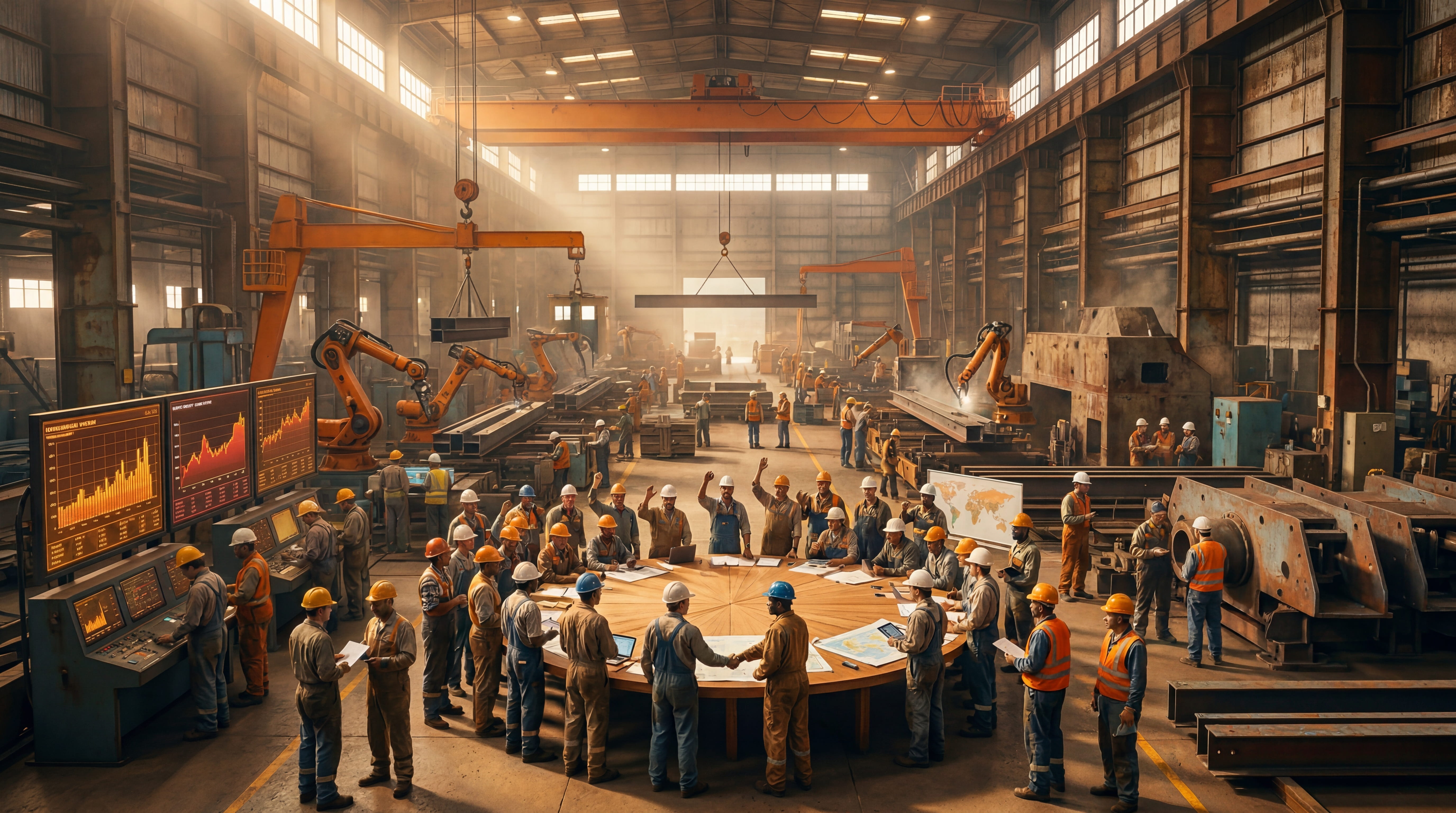
This is the case for markets without masters: a market economy that keeps everything markets do well — competition, choice, the coordinating genius of price — but whose largest owner is not a handful of funds serving a handful of people. Imagine, instead, a great pool of productive assets owned not by a small group at the top but by ordinary people, in vast number, each holding an equal share — and governed not by the size of anyone’s stake but by the principle of one person, one voice. Such an owner would still compete in open markets, under the same laws, winning or losing on whether people actually choose what it offers. It would hold no army, levy no taxes, and jail no one; it would be a participant in the economy, not a ruler over it. But its gains, instead of flowing upward to a few, would flow outward to the many who own it — the same many who, as customers and as voters, the captured version was quietly working against.
That single adjustment — not abolishing markets, not nationalizing them, but distributing their ownership — threads the needle the twentieth century could not. It keeps the competition and accountability that make markets and democracy work, while removing the concentration that let both be captured. It is neither the right’s faith in unowned markets nor the left’s faith in the state, but a third path that takes the tools both sides were fighting over and simply puts them in everyone’s hands.
The turn
This is where Part 1 ends and the rest of the work begins. The diagnosis is complete: the disease is concentration, in private hands or public ones, and the cure is not a new master but the absence of one — ownership spread so widely that no one can capture it. That is the principle. It is, deliberately, only a principle so far: it does not yet say what such an owner would actually be, how it could be built, what it would buy, how it would be governed, or how it would keep its own power from concentrating over time. Those are exactly the questions the next part takes up.
Because a principle, however sound, persuades no one until it is made concrete. The chapters that follow set out to do precisely that — to turn “markets without masters” from an elegant idea into an institution that could actually exist, and to show, step by careful step, that it can. [Cross-ref: Part 2 introduces the institution this principle points to.]
Join the conversation
This series belongs to everyone, including its critics. Tell us where you were convinced and where you were not — and if you see a way to make the proposal stronger, say so. You'll need a free account with a handle of your choosing.
Reset your password
Enter the email you signed up with. If it's registered, we'll send you a link to set a new password.
Be the first to comment.