

Who This Is For
Article 2-3
Who This Is For
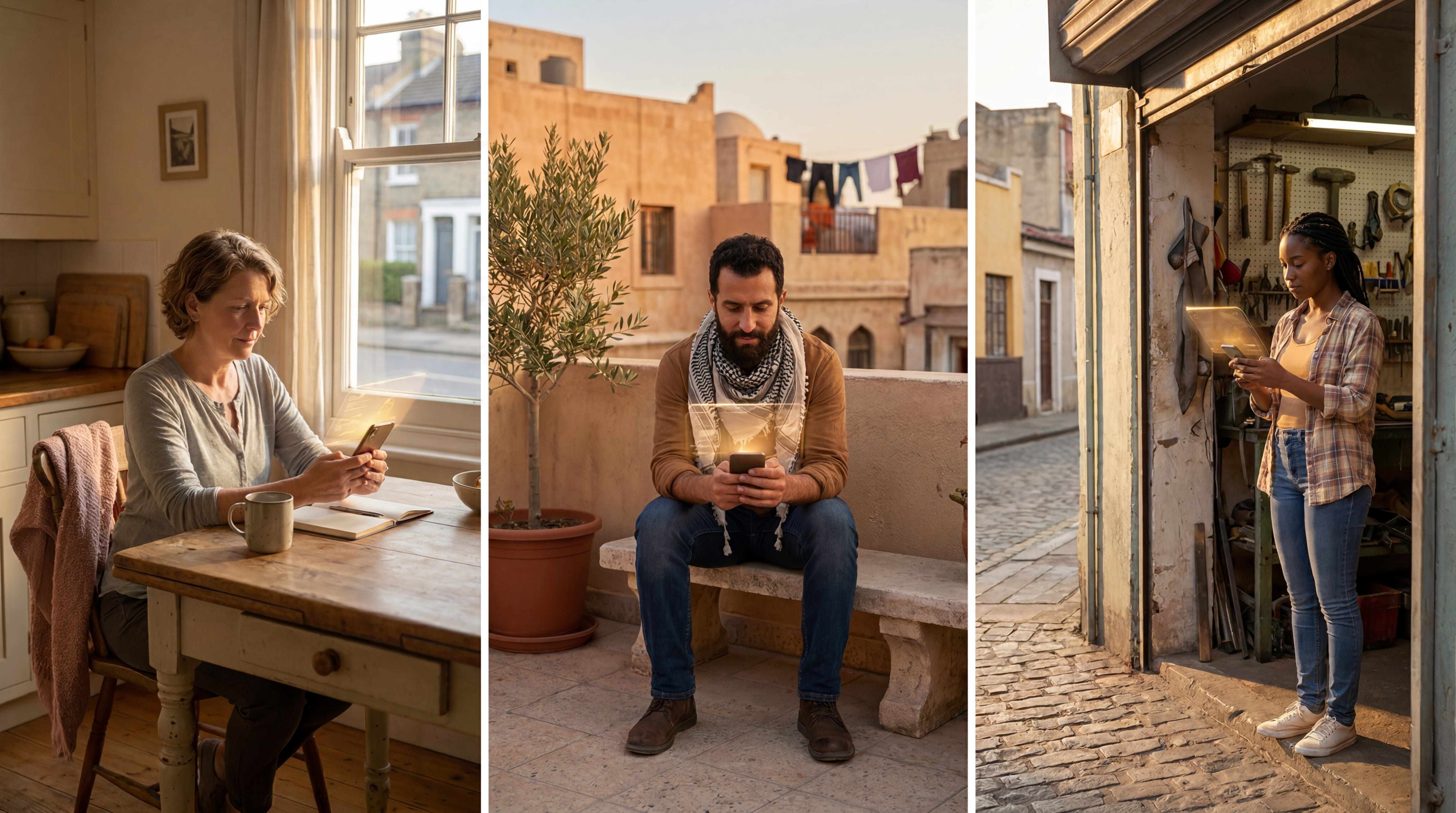
Wealth dictates what is available to you. This asks something different: not whether you have enough money, or the right passport, or any particular standing in the world, but whether you hold certain moral values — and whether you believe that, built on those values, the world could be fairer than it is, and that ordinary people, acting together, could build the fairness no one is going to hand them. The fund is for the people who hold those values, or who come to learn them. Everything else — your income, your country, your work, your past — is beside the point.
So this article is not really a list of who qualifies. It is an answer to a question the reader is probably already asking: is this for me?
It is for the people who share its values
At its simplest, the fund is for anyone who holds the convictions the last article described: that every human being is equal in worth, that dignity is owed to everyone, that an economy should serve the people in it rather than extract from them, that a fairer world would be a more peaceful one. [Cross-ref: Article 2-5 — The Fund’s Values.] If those ideas feel true to you, then the fund is for you — whoever you are, wherever you live, whatever you earn. It was built for exactly the person who reads those convictions and thinks: yes, that is what I have always believed; I simply never had a way to act on it.
For that person, the fund is not a conversion. It is a recognition — a structure finally put under a belief they were already carrying. They tend to arrive quickly, because nothing in them has to change first. They were waiting for this without knowing its name.
It is also for the people who have to arrive slowly
But there is a second person this is for, and the fund cares about them just as much: the one who feels the pull of these ideas and also feels a quiet resistance, because everything they were ever taught says the ideas are naive.
Most of us were raised inside a set of assumptions we never chose and rarely examine. That greed is simply human nature, fixed and universal. That inequality is the natural and inevitable order of things. That there is no alternative to the world as it is — that this, more or less, is the only way an economy can work. That self-interest is the only realistic foundation to build anything on, and that any system relying on people to cooperate is doomed to fail. These beliefs are taught so early and repeated so often that they stop feeling like beliefs at all and start feeling like facts about reality.
For someone who has absorbed all that, the fund cannot be accepted at first sight, because it contradicts the floor they are standing on. They have to do harder work: to take those inherited assumptions out, one by one, and actually look at them — to ask whether greed is human nature or just what a particular kind of economy rewards; whether inequality is inevitable or merely engineered and defended; whether “there is no alternative” is a truth or simply the most useful thing for the comfortable to believe. That process is a kind of deconstruction — a dismantling of what was assumed — and only after it can the person begin to rebuild, on the same values, by their own reasoning rather than by inheritance.
This path is slower, and it is also, in a way, sturdier. A belief you reasoned your way back to, after doubting it honestly, holds better than one you were simply handed. The fund is built to last generations, and it will be carried in the end not only by the people who believed instantly but by the many who had to think their way there — who started from skepticism and arrived, by their own road, at conviction.
It is an invitation, not a test
Here is the part that matters most, and the fund means it without reservation: you do not have to already agree to be welcome here.
The fund is not a club that admits only the converted and turns away the doubtful. It does not demand that you pass a test of belief at the door. If you are not yet sure — if part of you is drawn to these ideas and part of you suspects they cannot work — that is not a disqualification; it is the most honest place to begin. The fund would rather have a member who arrived full of questions and stayed because the answers held up than one who agreed without ever examining why. Doubt, here, is not the opposite of belonging. It is often the first step toward it.
So the invitation is open in the widest possible way. It is open to the person who already believes and only needed somewhere to put that belief. It is open to the person who wants to believe but cannot yet get past what they were taught. It is even open to the person who mostly disagrees but is willing to keep reading, keep questioning, and see where the argument leads. No one is shut out for arriving late, or arriving unsure, or arriving by a long and doubting road. The only thing the fund asks is a willingness to consider that the world could be better than it is.
Who, then, is it for?
It is for the worker and the professional, the person with much and the person with almost nothing — but not because of their income, which is the wrong lens entirely. It is for them because the conviction the fund is built on does not belong to any class or country. The wish for a fairer world is one of the most widely shared feelings human beings have; what has been missing is never the wish, but the means.
So the fund is for whoever holds that wish, however they came to it and however certain they are of it — the ones who knew at once, and the ones who had to take their whole inherited picture of the world apart and build a truer one in its place. If you have read this far and something in you is still listening, then in all likelihood the answer to is this for me? is yes. It was built for people exactly like you: people who suspect the world does not have to be this way, and who are willing to help prove it.
Join the conversation
This series belongs to everyone, including its critics. Tell us where you were convinced and where you were not — and if you see a way to make the proposal stronger, say so. You'll need a free account with a handle of your choosing.
Reset your password
Enter the email you signed up with. If it's registered, we'll send you a link to set a new password.
Be the first to comment.