

How the Fund Works
Article 2-2
How the Fund Works
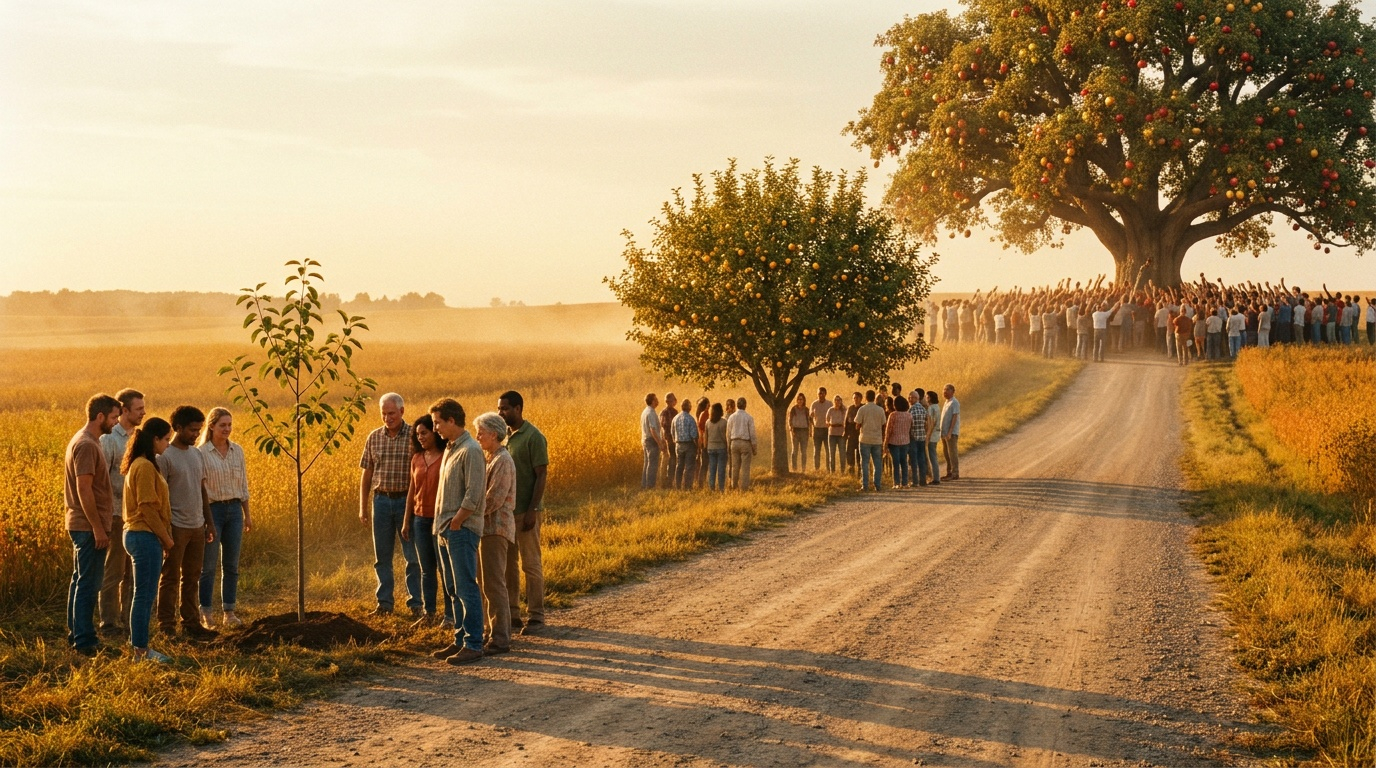
The previous article introduced the fund in its simplest form: a dollar a month, an equal share for everyone who joins, profits owned in common. This article explains how that frame actually works — how the money comes in, how it grows, who owns what, and how a movement that starts small could, over a lifetime, come to be owned by most of humanity.
One point from that frame is worth holding onto before we go further, because everything here depends on it: every member, paying the same dollar, receives the same equal share — equal ownership, equal dividends, one equal vote — whether they live in a village or a capital city. That equality is not a slogan; it is the architectural rule the entire institution is built to protect. Multiplied across hundreds of millions of people, month after month, that small contribution becomes one of the largest and most predictable pools of capital in the world — money that arrives not from investors expecting to be served first, but from ordinary people who will own what it builds.
How a small start becomes a large institution
The fund does not need everyone to join at once. It needs enough people, early enough, to make its first bank and its first company real. After that, the thing builds on itself.
The honest, careful version of that growth — the version our financial model is built on, and the one the rest of this series uses — is deliberately modest. It assumes the fund begins with a few million members, not a few hundred million, and grows steadily rather than explosively: roughly eight million members in the first year, climbing into the tens of millions over the first few years, and reaching something near four hundred and seventy million by the end of the first decade. In that decade the fund opens its first banks, makes its first acquisitions, and begins — slowly — to pay a dividend. We walk through that decade year by year elsewhere, and we show the full financial model openly, because a movement that asks for trust should show its arithmetic. [Cross-ref: Article 5-9 — The First Decade; Article 5-5 — The Fund’s Financials Through the Years.]
That modest path is the floor, not the ceiling. It is what the fund looks like if adoption is merely good. The reason to believe it could be far larger is that products with a tiny entry point, a global reach, and a sense of belonging have spread across humanity before, astonishingly fast. Cryptocurrency — a far more complex and far riskier thing than a dollar-a-month membership — grew from roughly thirty million users in 2017 to about eight hundred and thirty million by 2024, nearly twenty-eight times in seven years. [Source: crypto adoption data, socialcapitalmarkets.net, 2024.] The fund asks less of a person than crypto did — no volatility, no technical complexity, no risk of loss — and offers something crypto never could: real ownership of real companies, and an equal vote in them. If a speculative asset could reach hundreds of millions that quickly, a fairer economy that costs a dollar can reach further.
The vision: a fund owned by most of humanity
So picture the far end of the road, not as a promise but as the thing the fund is built to become if people choose it.
There are about eight billion people alive today. The United Nations projects that number will keep rising for roughly another sixty years — passing nine billion around 2037, ten billion around 2061, and peaking near ten and a third billion in the mid-2080s before gently declining. [Source: UN World Population Prospects 2024.] The pool of people the fund could serve is not fixed; it grows for the rest of most members’ lives.
Now imagine the fund reaching most of them — not all eight billion on day one, but the steady majority of humanity arriving over decades, the way every large movement in history arrived: a few, then many, then most. A fund that ordinary people keep choosing, that pays them back in cheaper goods and fairer banking and a real vote, has every reason to keep growing as long as it keeps its promises. And because membership begins at birth — a newborn can be enrolled by their family, their dollar contributed on their behalf, their dividends held safely until they come of age — each new generation is born into the fund rather than having to discover it. A movement that the next generation inherits does not have to be rebuilt each lifetime; it compounds.
That is the vision: not a company that serves the 99 percent, but an economy owned by them — growing with humanity itself, generation after generation, until being a member of the fund is simply part of what it means to be a person in the world. The modest model is what we can defend on paper. This is what it is for.
The snowball: how the money grows itself
Return to the mechanism, because the vision rests on it. In the earliest years the fund runs on contributions — the dollars members pay in. But contributions are only the seed. Once the fund owns banks and companies, those begin to earn, and their profits are reinvested to buy more — so that over time the fund grows less from new members’ dollars and more from its own earnings. The contributions light the fire; the fund’s own profits keep it burning.
There is a second engine that matters even more, and it is one members control directly: their own spending. When members buy their food, medicine, and basics from the companies they collectively own, those companies grow — and because the members own them, the profit returns to the members. A fund whose members buy its products grows far faster, and pays far more, than one whose members merely contribute. The dollar a month was never the real power. The real power is hundreds of millions of people choosing to buy from themselves. [Cross-ref: Article 3-1 — What You Would Earn.]
The fund enters one industry at a time — stabilizing it, using its profits to fund the next — beginning with high profit margin packaged goods and essentials like generic medicine and staple foods, where lower prices help people most and where the fund is hardest to attack. It does not try to own everything. It deliberately keeps competitors alive and caps its own share of the economy, so that members always retain the ultimate power over it: the freedom to take their money elsewhere if the fund ever stops serving them. [Cross-ref: Article 5-6 — What Industries, and in What Order on which industries and in what order.]
Generosity speeds it up; it never buys control
Some people will want to give more than a dollar. They can — but what they are doing is paying future dollars early, not buying a larger stake. The governance rule never bends: one person, one vote, one equal share, regardless of how much anyone contributes. Financial generosity earns gratitude and makes the fund grow faster. It does not earn a larger voice, a larger dividend, or any special treatment whatsoever. This separation of financial power from democratic power is the single rule that keeps the fund from becoming the very thing it was built to replace — an institution where money buys control.
The same principle runs the other direction, toward those who have least. Some people cannot spare even a dollar a month. They are not left out: a solidarity arrangement lets members who have more cover the identical contribution for one or more people who have less — not a lesser membership, but a full and equal one, with a full and equal vote, paid on their behalf. And as the fund matures and dividends grow, a member’s own dividend increasingly covers their contribution, so the help needed in the early years quietly shrinks over time. [Cross-ref: Article 3-1 — What You Would Earn.]
That is how the fund works: a dollar a month, equal ownership, one vote each, money that grows itself and grows faster when members buy from what they own — beginning as a few million and built to become, over a lifetime, an economy owned by most of the people on earth.
Join the conversation
This series belongs to everyone, including its critics. Tell us where you were convinced and where you were not — and if you see a way to make the proposal stronger, say so. You'll need a free account with a handle of your choosing.
Reset your password
Enter the email you signed up with. If it's registered, we'll send you a link to set a new password.
Be the first to comment.