

The Fund's Values
Article 2-5
The Fund’s Values
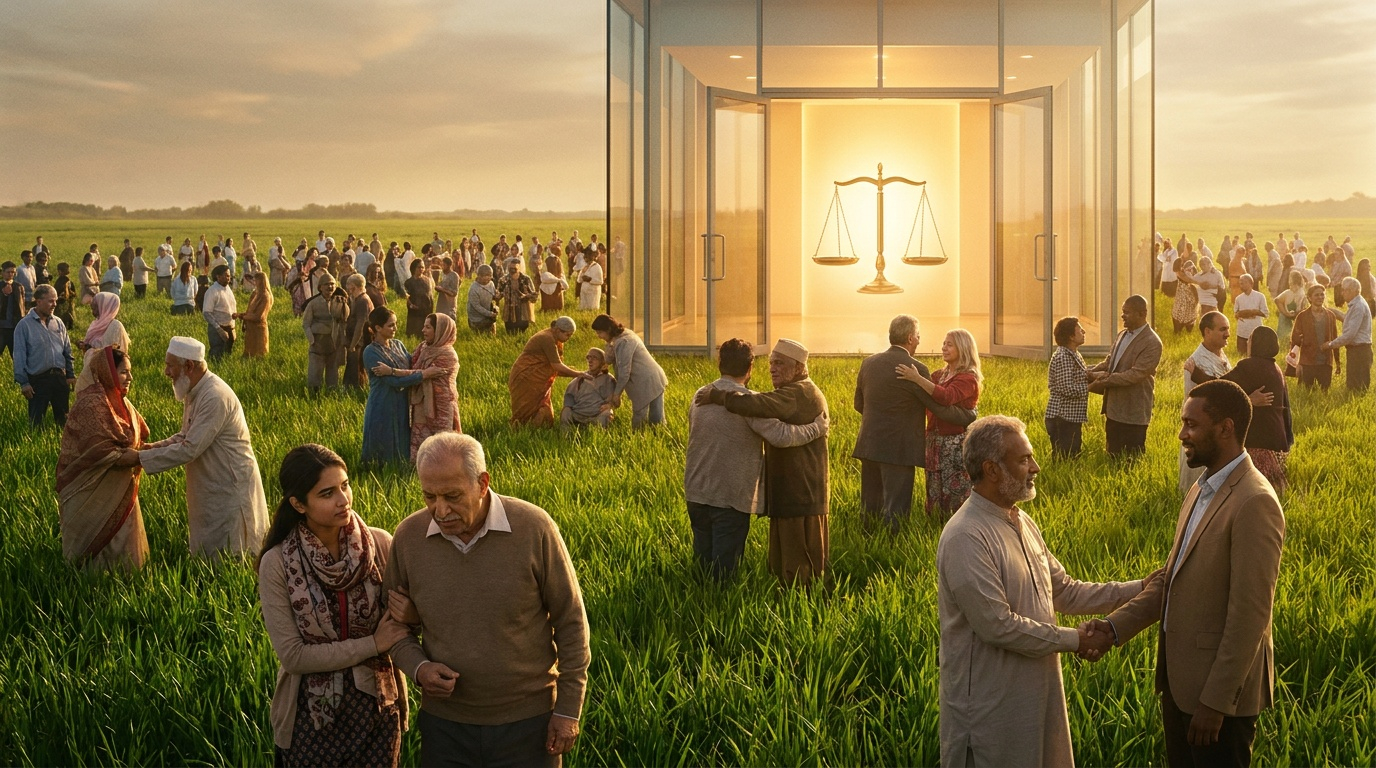
You have now read what the fund is, how it works, who it is for, and what it refuses to become. Underneath all of it sits a simpler and more important question, one that comes before any of them: why do this at all? An institution this demanding to build is worth building only for a reason large enough to justify it. This article is about that reason — what the fund believes about the world, what it is trying to repair, and why the way it treats its own members is the same as the way it believes every human being should be treated.
Why we are doing this
Look honestly at what tears the world apart, and a pattern appears beneath almost all of it. War, neocolonial power, economic exploitation, social unrest, mass migration, extremism, the slow violence of oppression and hunger — and even death — these are not random misfortunes. They grow, again and again, from the same soil: injustice. From people denied a fair share of what their work and their land produce. From whole nations left with no future while the wealth they generate flows elsewhere. From the steady, grinding experience of being treated as worth less than others because of where you were born, what you look like, or what you believe. Abuse, desperation, and humiliation are the raw materials of every conflict, and the world manufactures them in enormous quantity.
The fund begins from a conviction about this: a fairer world is a more peaceful world. Most of the violence and instability that fills human history is downstream of economic injustice — and so the most certain way toward peace is not to manage the symptoms after they erupt, but to correct the injustice at its root. If people have a fair stake in the economy they live in, if the wealth of a place reaches the people of that place, if no human being is treated as disposable, then the conditions that breed conflict begin to dry up. The fund is not a peace movement in the usual sense. It is something more practical: an attempt to remove, at scale, the economic unfairness from which so much human suffering actually springs. We are doing this because we believe that is how you build a more peaceful world — not by preaching at it, but by making it fairer.
What we stand for
Beneath that purpose sit a few convictions the fund holds without apology.
That every human being is equal — fully, exactly equal — regardless of race, origin, nationality, religion, or any other accident of birth. Not equal in talent or luck, which no one can arrange, but equal in worth and in their claim to be treated justly.
That human dignity is real and owed to everyone, and that an economy which treats people as inputs to be used as cheaply as possible is an affront to it.
That human rights are not privileges granted by the powerful but entitlements every person holds simply by being human — and that economic security is among the conditions that make the other rights meaningful.
And that international law and justice — the hard-won idea that nations and the powerful are bound by rules, that might does not make right, that the weak are owed protection — are worth defending and building upon, not discarding the moment they become inconvenient to someone who wants to abuse their power for their own benefit.
These are not novel ideas. They are the stated ideals of most of humanity, written into declarations and constitutions all over the world. What is missing is rarely the belief; it is an institution that actually runs on these convictions instead of merely professing them. That is the gap the fund means to fill.
A fund that lives the world it wants
Here is the heart of it, and the reason the rest of this series spends so long on governance and structure. The fund does not ask the world to become fair while itself being run like everything else. It is built to be the fairness it argues for — to embody, inside one institution, the exact world it wants to see.
So look at how the fund treats its own members, and you are looking at the world the fund is trying to build. Every member is equal: one share, one vote, one dividend, the villager and the financier holding precisely the same stake. Everyone has a voice and a say in what the institution does. No single person, no family, no faction, no government, and no amount of money can seize control of it or bend it to serve them above the rest. The powerful are bound by its rules; the weakest member is protected from any majority. The fund, in other words, treats its members exactly the way it believes every human being deserves to be treated by the world they live in.
This equality is of worth, voice, and dignity — not of outcome. Some members will earn more than others: the one who opens a local business with the help of the fund’s bank, or who earns royalties from an invention everyone wants. But even the wish to earn more pulls a member deeper into the social fabric rather than away from it. You want your neighbors to buy what you make locally, or to invest in your business; you want the global membership to vote for your invention so the fund will produce it and members will buy it. Ambition itself, inside the fund, runs through other people. It is a constant reminder that we need each other to reach our own dreams — and that others need us to reach theirs.
This is what makes the fund’s values trustworthy rather than merely stated. Anyone can declare that they believe in equality and justice; the declaration costs nothing and is broken every day. The fund’s claim is different in kind, because it has built those values into its own machinery and submitted itself to them. It does not preach a fairness it has exempted itself from. It practices, on hundreds of millions of its own members, the fairness it hopes to spread to billions. The institution is a working model — a small, living proof — of the world it is trying to make.
Keeping faith with these values
A conviction is only worth as much as its defenses, and the fund assumes its values will be attacked — by greed, by ambition, by the patient effort of anyone who would turn the institution to their own ends. So it does not merely hold its values; it fortifies them, building each one into structures designed to survive bad actors and bad days.
Equality is made structural. Money may buy more contribution to the fund, never more control of it; the separation of financial power from democratic power is the rule from which the fund’s character flows. [Cross-ref: Article 4-1 — One Person, One Vote; Article 2-1 — The 99% of Humanity Global Fund.]
Power is always recallable and always limited. Managers execute the members’ will and can be removed; the fund’s AI sees everything and decides nothing; the deepest rules sit in a constitution no ordinary majority can touch; and the fund caps its own share of the economy so members can always walk away if it fails them. A value that depends on the goodness of whoever is in charge is only a hope; the fund’s values are built to outlast bad leadership. [Cross-ref: Article 4-2 — AI at Its Core; Article 4-1 — One Person, One Vote; Article 3-2 — Pricing and Competition; Article 5-6 — What Industries, and in What Order.]
Honesty is a discipline, not a mood. The fund tells unwelcome truths — that the dividend is small for years, that benefits come slowly, that it will lose some battles, that no dividend can cure poverty — because a movement meant to last generations cannot afford to be caught overpromising. Its credibility is its most precious asset. [Cross-ref: Article 3-1 — What You Would Earn; Article 5-5 — The Fund’s Financials Through the Years.]
Transparency is the default; privacy is the line. Everything the fund does with its power is open to audit; everything about a member’s private life is sealed. Power that cannot be watched cannot be trusted — and a person’s private life is theirs alone. [Cross-ref: Article 4-2 — AI at Its Core.]
Fairness reaches beyond the membership. The fund prices essentials fairly for everyone who shops, keeps its competitors alive on purpose, pays fair wages that passively pressure whole industries, and rewards inventors for as long as their work has worth. It is not a club that extracts from outsiders for insiders; it aims to improve the economy for everyone it touches, including those who never join. [Cross-ref: Article 3-2 — Pricing and Competition; Article 3-3 — Manufacturing the World Fairly; Article 3-5 — The Fund and the Entrepreneur.]
The horizon is long. The fund is built to grow slowly and be felt across generations — membership begins at birth, the deepest rules are written to outlast everyone now living, and the whole project is meant to compound across lifetimes. It measures itself in decades because the new order it is building, a fairer and more peaceful world, is the work of more than one. [Cross-ref: Article 2-1 — The 99% of Humanity Global Fund; Article 5-9 — The First Decade.]
That is what the fund believes, and how it keeps faith with what it believes. It exists because a fairer world is a more peaceful one, and because the injustice that breeds so much suffering can be corrected at its economic root. It stands for the equality, dignity, and rights of every human being, and for a world governed by justice rather than power. And it earns the right to argue for that world by being it — treating every one of its members exactly as it believes every person on earth deserves to be treated. The values are not on a wall. They are the load-bearing walls themselves.
Join the conversation
This series belongs to everyone, including its critics. Tell us where you were convinced and where you were not — and if you see a way to make the proposal stronger, say so. You'll need a free account with a handle of your choosing.
Reset your password
Enter the email you signed up with. If it's registered, we'll send you a link to set a new password.
Be the first to comment.