

The Fund and the Entrepreneur
Article 3-5
The Fund and the Entrepreneur
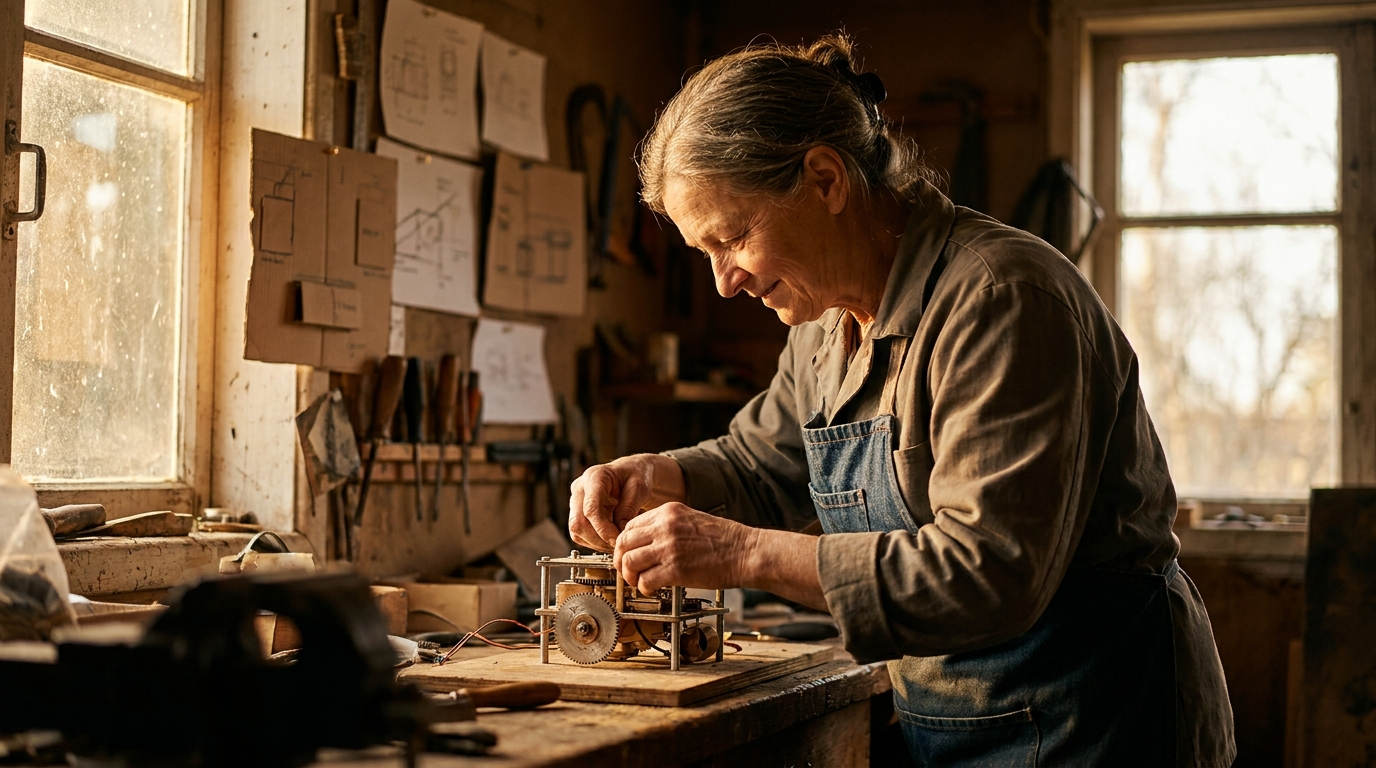
For most of human history, having a good idea has not been enough. The person who could turn an idea into a business was almost never the person who had the best idea — it was the person who already had money, or knew someone who did, or could afford the lawyer, or happened to be born in the right country. Talent is spread evenly across humanity; the means to use it are not. The fund’s deepest promise to entrepreneurs is to close that gap — to make a good idea, rather than access to capital, the thing that determines whether something gets built.
It does this in several ways at once, and together they amount to the most open system for turning ideas into income that has ever existed.
The bank that invests instead of lends
Start with the problem every small entrepreneur knows. To start or grow a business, you need capital. The conventional bank offers you a loan — at high interest, with all the risk on you. If the business succeeds, you repay the loan plus a heavy margin; if it fails, you still owe the money, and you may lose your home along with the business. The bank takes no risk and a guaranteed return; you take all the risk and a fragile chance. In much of the world the terms are worse still, or the loan is simply unavailable to someone without collateral or connections.
The fund’s bank works differently. For a business that fits its ecosystem, the bank can act less like a lender and more like a partner: it provides capital in exchange for a share of the business, with the entrepreneur holding the right to buy that share back as they succeed. The difference is everything. The risk is shared rather than dumped entirely on the founder — if the business struggles, the founder is not crushed by a debt that does not care whether they survived; if it thrives, they can buy back full ownership on fair terms and keep what they built. It is capital offered the way capital should be offered to someone with more talent than money: as a genuine partnership in the upside, not a trap baited with the downside. [Cross-ref: Article 5-7 — The Digital Bank: Why and When.]
For an entrepreneur in a place where banking has always been predatory or simply absent, this is not a marginal improvement. It is the difference between an idea that dies in someone’s head and a business that employs their neighbors. The fund’s bank, reaching into communities that conventional finance abandoned, becomes an engine of new business formation precisely where new business was impossible before — and every business it helps start is a reason for someone not to have to leave home to find a job instead of creating their own. [Cross-ref: Article 3-3 — Manufacturing the World Fairly.]
The democratic patent system: an idea judged by everyone
The second pathway needs no business and no capital at all — only an idea. We introduced it briefly as one of the ways a member earns; here is how it actually works, because it may be the most quietly radical thing the fund does. [Cross-ref: Article 3-1 — What You Would Earn.]
Anyone, anywhere, can submit an idea — a product, a service, an improvement to something that already exists. The fund’s information systems organize the viable submissions and present them to the membership, and members vote on what they would genuinely want built and would actually buy. If your idea wins that vote, the fund develops it, manufactures it, and distributes it through the global supply chain it already owns — and you earn a royalty on every sale for as long as your invention keeps selling. Your royalty is a share of each sale; the rest of every sale flows to the fund and so to all its members, which means everyone benefits from your invention from the very first unit, for as long as people keep buying it. If sales grow, your royalty grows; if they fade, it fades; when people no longer want your inventions, it quietly ends. The market itself decides how long your reward lasts — no arbitrary clock cuts it off while people still value what you made.
Consider what that removes from the path between an idea and the world. You do not need a patent attorney. You do not need a venture investor to believe in you. You do not need factories, or a distribution network, or startup capital, or the luck of knowing the right people. You need an idea good enough that millions of your fellow members, asked honestly, say yes, I would buy that. A farmer in one country and an engineer in another meet on perfectly equal ground, judged by the only jury whose verdict actually matters in a market: the people who would have to want your invention. The merit of the idea is the whole of the test. This is, in the most literal sense, a democratic patent system — invention opened to every human being instead of rationed to those who can afford its gatekeepers. And it is why a fund owned by millions can out-invent any single company: it has millions of minds looking for the next good idea, each with a real reward for finding it. [Cross-ref: Article 3-2 — Pricing and Competition.]
Members investing in members
There is a third pathway, between the first two: a marketplace where members can invest directly in one another’s ventures. A member with some savings and an appetite for risk with higher rewards can put money into a fellow member’s local business through the fund’s own systems — transparently, on fair terms, with the fund’s information tools helping both sides understand what they are getting into. This is its own money pool, separate from the safe deposits and the contribution capital, where the risk and the reward belong to the member who chooses to take them. [Cross-ref: Article 5-7 — The Digital Bank: Why and When.]
What this builds, over time, is a circuit of capital that stays among ordinary people: members funding members, neighbors backing neighbors, the savings of the many flowing toward the ideas of the many — instead of every promising venture having to seek out distant investors who will demand the largest possible share and the fastest possible exit. It is venture capital without the venture capitalist: patient, fair, and owned by the same community it serves.
A reward for those who build inside the fund, too
The same principle reaches the people who build within the fund’s own companies as an employee. A scientist who develops a new medicine, a designer who creates a product people love, an engineer who builds a system the whole fund relies on — these people earn not only a fair salary but an ongoing royalty tied to the value their work creates, for as long as it keeps creating value — the very same rule that applies to any member’s invention: the reward lasts exactly as long as the worth it is paid for, no longer and no shorter. Their reward is bound to the lasting worth of what they made, not to a one-time bonus or a stock price they might game. It is a way of paying creators what they are actually worth to the people they serve — and it lets the fund compete for genuine talent against companies that can offer far larger paychecks but nothing like the same connection between what you make and what you earn. [Cross-ref: Article 3-1 — What You Would Earn.]
Put the four pathways together and a picture emerges that has no precedent. A person with an idea and nothing else can have it judged by millions and earn from it worldwide. A person with a business and no access to capital can be financed as a partner rather than a prey. A person with savings can back their neighbor’s venture fairly. A person with a rare skill can earn in proportion to the lasting value they create. None of these depends on being born wealthy, or in the right country, or knowing the right people. And because all four push income outward and downward — toward the inventor without a lawyer, the founder without collateral, the saver backing a neighbor, the creator paid for lasting worth — they work together to spread wealth more evenly than the economy does today. Measured against the Gini coefficient, the standard gauge of inequality, the fund’s effect points in the right direction: not erasing the gap between rich and poor, which no single institution can do, but steadily narrowing it as each of these paths carries opportunity to people the old economy left out. The fund does not promise that everyone will succeed — nothing can promise that, and pretending otherwise would be a lie. What it promises is something no economy has offered before: that whether you get to try will depend on the quality of your idea and your effort, and not on the accident of how much money you started with. That is what it means to open entrepreneurship to everyone.
Join the conversation
This series belongs to everyone, including its critics. Tell us where you were convinced and where you were not — and if you see a way to make the proposal stronger, say so. You'll need a free account with a handle of your choosing.
Reset your password
Enter the email you signed up with. If it's registered, we'll send you a link to set a new password.
Be the first to comment.