

The 99% of Humanity Global Fund
Article 2-1
The 99% of Humanity Global Fund
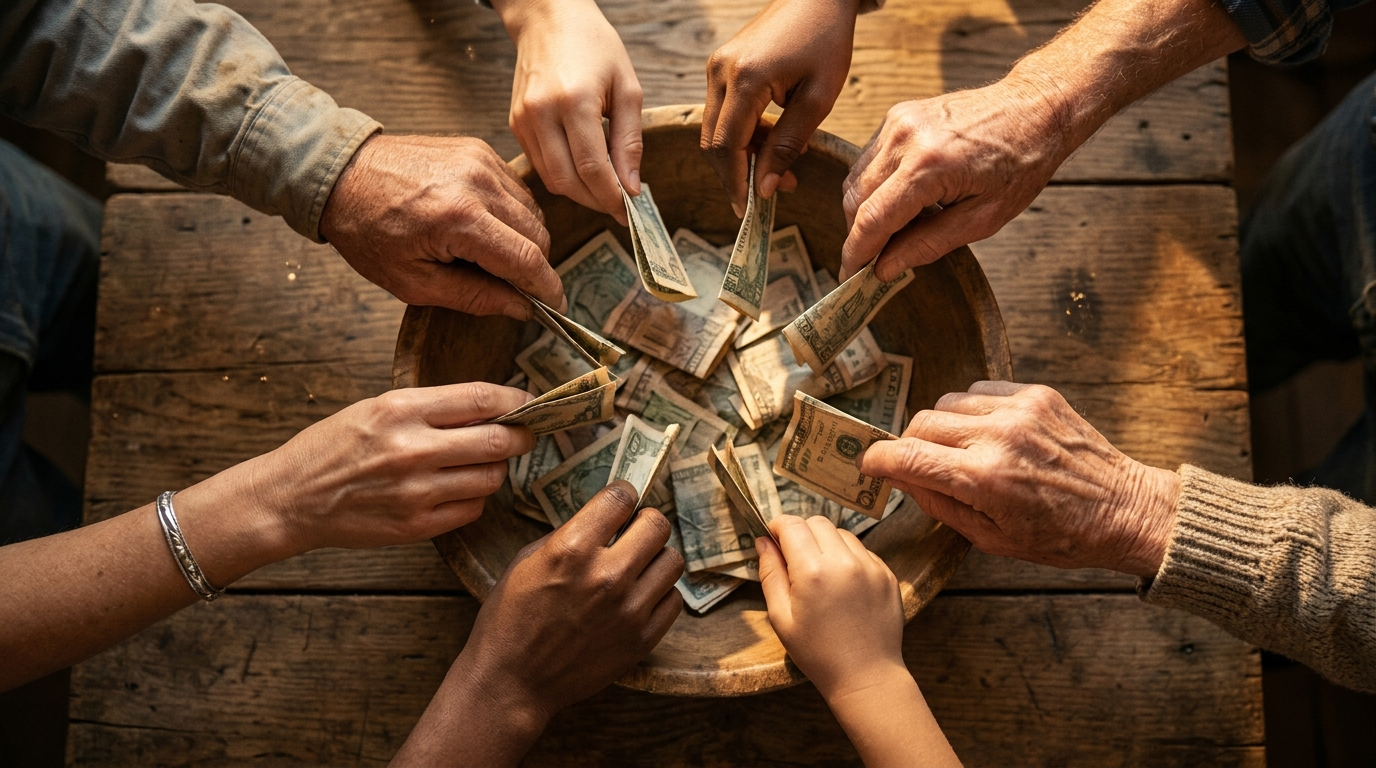
After four articles of diagnosis and one of warning, it is time to say plainly what this series is proposing. The institution that Part 1 kept pointing toward, without naming, has a name: the 99% of Humanity Global Fund. This article introduces it in its simplest form. Everything after it — the ownership, the competition, the money, the governance, the defenses — is the detailed answer to the questions a careful reader will immediately start asking.
Here is the whole idea in one breath. People join and contribute one dollar a month. The pooled money is used to build new global companies and to buy existing ones, in the industries that shape ordinary life. Those companies compete in the open market like any other, and the profits flow back, in equal share, to the people who own the fund — which is to say, to its members. No member owns more of it than any other. No member has more say than any other. It is, in the most literal sense, a company owned by humanity, run for humanity, one dollar at a time.
That is the bumper-sticker. The rest of this article adds just enough detail to make it real, and to correct the first misunderstanding it usually provokes.
The dollar, and who can join
The contribution is one dollar a month. It is deliberately small — small enough that it is not really about the money. A single dollar from one person builds nothing; what the dollar does is make the person a member, an equal co-owner of everything the fund comes to own, with one equal vote and one equal share of its profits. The dollar is the key to the door, not the engine of the house. [Cross-ref: the engine is explained in Part 5 — early on, it is the fund’s own bank, not the contributions, that does most of the work.]
Membership is open to every human being, and it begins at birth. A family can contribute the dollar on behalf of a newborn, with that child’s dividends accumulating in an escrow account they can claim on reaching adulthood; if the child does not live to claim it, the contributions are returned to whoever made them. Think of what that means: you are helping to build a changed world for the generations to come, and they will inherit a stake in it before they are even old enough to understand what the fund is.
And for those who genuinely cannot spare a dollar, a separate sponsorship fund lets members of means cover others’ contributions — buying them not charity but ownership, a permanent equal stake. That sponsorship fund matters most in the early years and shrinks over time, because as the fund matures, a member’s own dividends eventually grow large enough to cover their dollar by themselves. The help is designed to make itself unnecessary. [Cross-ref: Article 2-3 — Who This Is For; Article 3-1 — What You Would Earn.]
Why it does not need everyone at once
The first misunderstanding to clear up is one of scale. It is tempting to imagine the fund only works if all of humanity joins and contributes at once — eight billion dollars a month, an unimaginable investment chest overnight. That is not how it works, and it is important to be honest that it is not, because the honest version is more believable.
The fund does not need everyone. It needs enough people, early enough, to make its first moves — and then it grows the way successful institutions actually grow: from a modest start, compounding. The realistic picture, worked out in detail later in this series, begins with roughly eight million members in the first year, not eight billion, producing on the order of eighty million dollars of contribution income — real, but modest. From there it climbs as word spreads: tens of millions of members within a few years, and on the order of four to five hundred million by the tenth. [Source: adoption model, Part 5.] The closest real-world comparison is cryptocurrency, which went from roughly thirty million users in 2017 to over eight hundred million by 2024 — a financial product with a tiny entry point, global reach, no need for a traditional bank account, and a community that drove adoption across every language and income level. [Source: crypto user data, 2024.] The fund asks for something far simpler than crypto and offers something crypto never did: not a bet, but ownership.
And those are the cautious numbers. Now imagine the other case — that people grasp what this could do for their lives and for the world, and share it the way good ideas spread. Imagine the early years bring many times eight million members, and the tenth year after memberships open passes not four or five hundred million but a billion. Nothing about the design changes; the only difference is that the world is improved sooner and the snowball gathers faster. The cautious path is the promise. The enthusiastic one is the invitation.
The snowball
Here is the part that makes the modest start matter. The fund is built to become its own engine.
In the early years it is lean — the contributions are real but small, and the first profitable pieces are only beginning to come online. The detailed trajectory is laid out in Part 5, but the shape is this: the fund’s own bank, which serves members and turns a steady margin, becomes the financial fuel of the early years, while the first company acquisitions are still rare. The fund completes its first company purchase around the sixth operating year and owns on the order of a dozen-and-a-half companies by the tenth operating year — each one generating profit that is reinvested into the next acquisition. The dollar contributions remain the foundation, but with time the fund’s own profits overtake them as the main source of its growth. [Source: financial model, Part 5.]
That is the snowball: a small push at the top of the hill, and then a mass that gathers itself. The early members are not waiting for everyone else to join before anything happens. They are starting the roll.
One industry at a time
The fund does not try to insert itself into every industry at once, and it never tries to own any industry completely. It moves in sequence: enter one industry, establish itself, use the profits to become the first in its industry, and then to enter the next, and repeat. Each successful step proves the model to a watching public and pays for the step after it.
The suggested place to begin is high-margin packaged goods and generic medicines in particular — because public anger at the price of essential drugs is so widespread that a fund offering them honestly would meet immediate goodwill. But that is a suggestion, not a decree: the first generation of members decides where to start. [Cross-ref: Article 5-6 — What Industries, and in What Order.] And in every industry it enters, the fund competes alongside private companies rather than replacing them. Its built-in advantage is simple — its members are also its customers, and they receive dividends from what they buy from fund-owned companies — so its share of a market tends to grow over the years by ordinary choice rather than by force. The aim is never to become a monopoly. It is to become the largest competitor in the room, the one owned by everyone. [Cross-ref: Article 3-2 — Pricing and Competition.]
Tiered contributions, equal votes
A natural question is whether someone who wants to give more than a dollar may do so. They may — but with one firm rule that defines the whole character of the fund: extra money buys nothing extra in power or profit. A larger contribution is treated as future dollars paid early — it speeds the fund’s growth and earns genuine gratitude — but it never buys a larger vote or a larger dividend. The governance principle is absolute and never bends: one person, one vote, one equal share, regardless of how much anyone gave. [Cross-ref: Article 4-1 — One Person, One Vote.]
This is the line that separates the fund from everything it is built to replace. In the institutions of the captured economy, more money always means more say; that is the very mechanism by which power concentrated in the first place. The fund breaks that mechanism at its root. Money can speed it up. Money cannot buy it. And that single refusal — to let wealth purchase control — is what keeps a fund owned by everyone from slowly becoming a fund owned by the few.
What comes next
That is the fund, in its simplest honest form: a dollar a month, equal ownership, equal votes, profits returned to the many, growing and positively impacting one industry at a time from a modest start into its own engine. Stated this plainly, it raises exactly the hard questions the skeptic in the previous article asked — what it really owns and how that grows, how it competes and wins, how the money actually flows, how it is built and governed, and what keeps it from becoming the very kind of empire it was made to answer. The articles that follow take those questions one at a time. The idea has now been named. The rest is the proof. [Cross-ref: Part 2 continues with how the fund works in detail.]
Join the conversation
This series belongs to everyone, including its critics. Tell us where you were convinced and where you were not — and if you see a way to make the proposal stronger, say so. You'll need a free account with a handle of your choosing.
Reset your password
Enter the email you signed up with. If it's registered, we'll send you a link to set a new password.
Be the first to comment.