

The Fund's Media
Article 5-8
The Fund’s Media
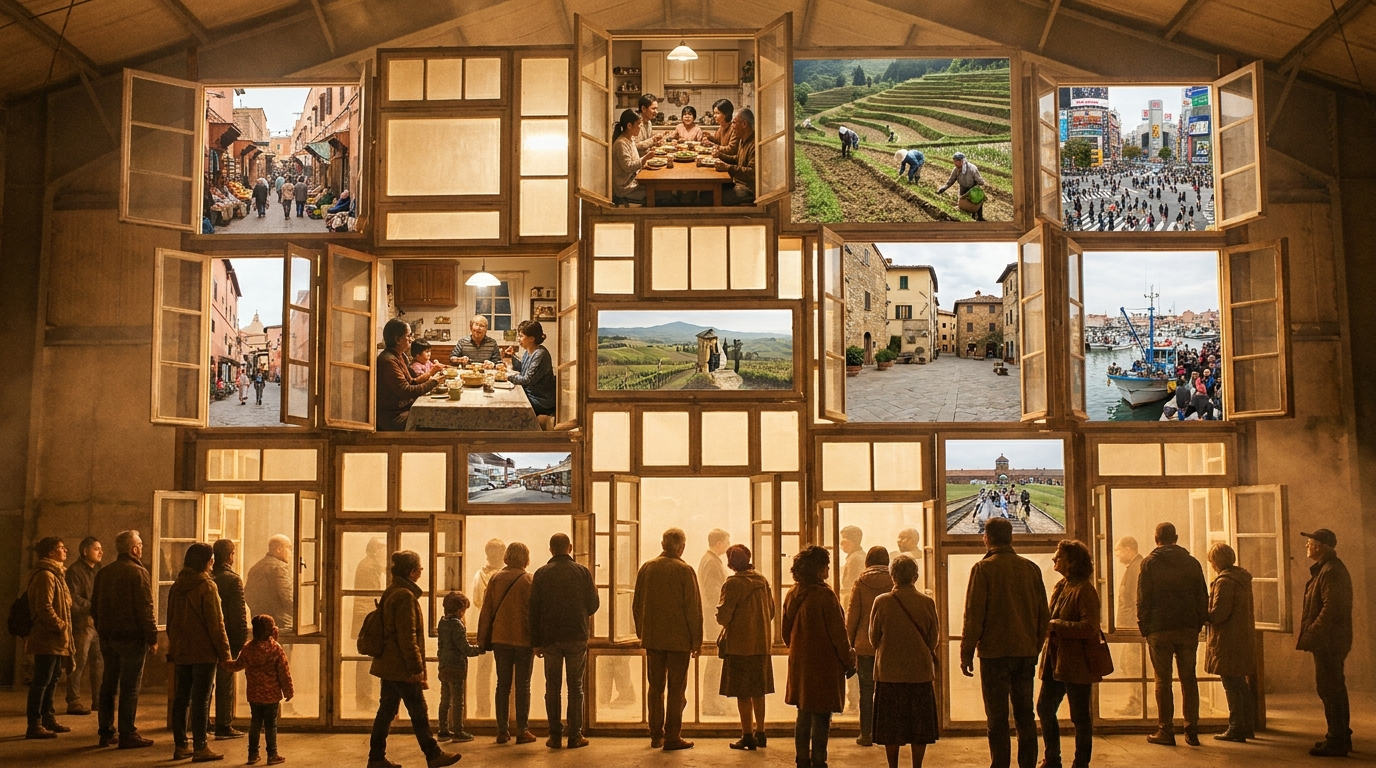
There is an old Spanish saying: ojos que no ven, corazón que no siente — what the eyes do not see, the heart does not feel. It is usually offered as a small comfort, the idea that we are spared the pain of what we never witness. But turn it around and it states the exact problem the fund’s media exists to solve. If you cannot see what is happening in the world, you cannot feel it — and if you cannot feel it, you will never act on it. Most of the world’s injustice survives not because people are heartless, but because it happens out of sight, to people we were never shown. The heart cannot move toward what the eyes were never allowed to find.
This is why the fund builds media of its own. Not to tell people what to think — that is propaganda, and the fund refuses it — but to let people see: to show what is happening across the world, honestly and from many perspectives, so that the people who own the fund can feel what is real and decide for themselves what to do about it. Awareness is the beginning of action, and a movement that means to repair the world must first let the world be seen.
The obvious and serious objection
And there, a careful reader should stop and push back hard, because the proposal just made sounds dangerously like the disease this entire series was written to cure.
The very first article of this series counted the cost of concentrated media: a tiny number of powerful people now own most of the world’s largest media companies and essentially all of its major social platforms, and they use that ownership to shape what billions of people see and do not see. [Cross-ref: Article 1-1 — Current Political Dynamics.] That concentration is one of the central ways power protects itself — by controlling the picture of the world that everyone else receives. So when a global fund, owner of companies across the economy, announces that it will also build media, the objection writes itself: how is that anything but one more concentrated owner deciding what the world sees? Why would the fund’s media be less of a captured megaphone than the billionaires’ is?
This is not a minor worry to be waved away. It is the single most serious objection to the entire idea, and if the fund could not answer it structurally — not with good intentions, but with design — then it should not build media at all, because it would risk becoming precisely the concentration of narrative power it claims to oppose. The rest of this article is that structural answer. It rests on three commitments, and the strength is in how they hold together.
Safeguard one: independence from the fund’s own managers
The first commitment is that the fund’s media does not answer to the fund’s managers.
A media arm controlled by the people who run the institution is a public-relations department, not a press, and everyone can tell the difference. So the fund’s media is governed at arm’s length from fund management, under its own protected charter, funded in a way that cannot be switched off as punishment for unflattering coverage. The people who direct the fund’s companies, set its strategy, and manage its money have no authority to order a story killed, softened, or planted. The wall between the institution and its press is not a matter of etiquette; it is built into the governance, the way the independence of a courtroom is built into a constitution rather than left to the goodwill of the powerful. An owner who cannot fire the editors for embarrassing him does not own the editors in any way that matters.
Safeguard two: many voices, not one line
The second commitment is that the fund’s media is a platform for plurality, not a single outlet broadcasting a single view.
The captured media’s deepest trick is not that it lies outright; it is that it narrows — it shows one frame and hides the others, so that a contested question arrives looking settled. The fund’s media is built to do the opposite. Its purpose, stated in the opening of this article and echoing the principle that governs the fund’s information systems, is to show events from many perspectives and trust people to judge — the same commitment the fund makes everywhere it touches information: present every serious side, and never dictate the conclusion. [Cross-ref: Article 4-2 — AI at Its Core.] In practice this means the fund’s media is less a voice than a stage: a place where many independent reporters, outlets, and viewpoints — including ones that sharply disagree with each other — can reach people, rather than one official channel handing down one approved story. A platform built to widen the frame cannot easily be used to narrow it.
Safeguard three: it must cover the fund itself, critically
The third commitment is the hardest, and it is the one that proves the other two are real: the fund’s media is required to report on the fund itself, including its failures, and to carry the voices of its critics.
This is the test that no captured media can pass. A billionaire’s outlet does not run sustained, unflattering investigations into the billionaire who owns it; that is exactly how you know who owns it. The fund inverts the rule. Its media is charted not merely to be allowed to criticize the fund but to be obligated to cover it as it would cover any other powerful institution — its mistakes, its internal disputes, its broken promises, the arguments of the people who think the whole project is wrong. A member should be able to open the fund’s own media and find, there, the strongest case against the fund, argued by its sharpest opponents. An institution willing to fund the publication of its own criticism is demonstrating, in the most costly and verifiable way available, that its media is not a mouthpiece. Anyone can promise independence. Paying for your own prosecution is proof of it.
Why the three hold together
Each commitment alone could be subverted; together they lock. Independence without plurality could still produce a single high-minded outlet that quietly reflects its founders’ tastes. Plurality without independence could be a crowded stage whose microphone is cut whenever the coverage stings. And both without the duty of self-criticism could still leave one comfortable blind spot exactly where it matters most — over the fund itself. It is the combination that does the work: independent, so the fund’s own staff cannot command it; plural, so no single view can crowd out the rest; and self-critical, so the institution’s own conduct is held to the same light as everyone else’s. Remove any one and the structure leans toward the captured model. Keep all three and it leans the other way — toward a press that serves the people who own it precisely by refusing to serve the institution they own.
How it handles harmful and false content — without becoming a censor
Principles are not enough; the harder question is the daily one. A platform that shows the world honestly will inevitably carry material that is violent, false, or ill-intentioned. How does the fund’s media deal with that without sliding into the censorship it exists to oppose? The answer borrows directly from how the fund handles power everywhere else: an automated system may see and flag, but it may almost never decide, and every contested judgment passes to people. [Cross-ref: Article 4-2 — AI at Its Core.]
In practice the fund’s media uses its AI as a first filter operating in three narrow tiers, and no more.
The first tier is reserved for the genuinely extreme — but the line here must be drawn with great care, because it is dangerously easy to draw it wrong. The tier is not “violence.” It is content that perpetrates or incites harm: material depicting the sexual abuse of minors, which is abuse in its very existence, and violence created to glorify, incite, or instruct further violence — a propaganda execution staged to recruit and terrorize, content whose purpose is to spread the harm it shows. For this narrow category, and only this one, the AI may place a momentary hold, replacing the content with a visible marker that reads, in effect, on hold, under review. It is the one case where material is hidden before a human looks, justified only because the category is narrow, near-universally condemned, and overlaps with the rare content that international law itself places beyond protection — so the fund’s commitment to free speech and the limits of international law agree rather than conflict.
But here is the distinction that the whole purpose of this media depends on. Violence shown as evidence is the opposite of violence shown to incite, and it must never be blocked. The footage of an atrocity, the documentation of a war crime, the witness recording of abuse — this is precisely the material that lets the world see, and so feel, and so act. If such evidence were suppressed, the saying that opened this article would curdle into its cruelest meaning: the eyes would be forced not to see, and the heart kept comfortably numb, exactly as the powerful prefer. A recent and terrible example makes the stakes plain: the violence documented in Gaza reached the International Court of Justice and moved people in many countries to press their governments precisely because it was seen. A platform that had dutifully blocked all “graphic violence” would have hidden the evidence and silenced the conscience it provoked. The fund’s media must never be that platform.
So documentary and evidentiary violence is not held. It is shown — behind a sensitive-content screen, so that those who do not wish to see it are not forced to, but those who need to bear witness can choose to. The author declares such material sensitive when posting it; if they do not, the AI may apply the sensitive material screen; either way the content remains visible by choice rather than removed. And the truly hard cases — where it is genuinely unclear whether an image is evidence or incitement, witness or propaganda — are not for the AI to settle at all, because the difference lives in intent and context, which no automated system reads reliably. Those cases route to the human committee described below, marked openly as under review, never quietly disappeared.
The second tier handles falsehood, and here the AI never hides anything. If a piece appears to assert or spread something untrue, the content stays fully visible, but the system attaches a marker — accuracy disputed — with a note, available on hover, that states precisely what the apparent inconsistency is and which source was used to assess it. The reader sees the original claim and the challenge to it, side by side, and decides. This follows what the most successful real-world experiments in this area have found: attaching context to contested content earns more public trust and teaches more than silently deleting it does, and a label that cites its source and its specific objection is harder to dismiss as mere suppression. [Source: studies on community-based moderation / context labeling, 2024-2026.] The AI is flagging a dispute, not declaring the truth — a distinction the fund guards carefully, because the power to declare what is true is exactly the power no automated system should hold.
The third tier is for the genuinely contested — content where a real tension exists between its apparent intent and the value of free expression, the cases reasonable people disagree about. Here the AI decides nothing at all. It routes the piece to a randomly selected committee of members who have volunteered to serve as safeguards, drawn from around the world, and it marks the content openly as under review while they consider it. This is the same dual-alert, un-erasable mechanism the fund uses to watch its own managers, turned toward content: the moment something contested is flagged, both a human author and a random human committee are notified, and the fact of the review is itself visible rather than hidden. [Cross-ref: Article 4-2 — AI at Its Core.] The use of a randomly chosen citizen panel is not an untested idea: membership organizations and public bodies have used randomly selected juries and citizens’ assemblies to resolve exactly this kind of values-laden dispute, precisely because a panel no one chose is far harder to capture than a committee someone appointed. [Source: sortition / citizens’ assembly practice, widely documented.]
Two further rules round out the design. Whenever the AI flags a piece, it tells the creator exactly what the objection is and offers a way to correct it — the author is never simply silenced; they are told the problem and given the chance to answer it. And any reader may flag content too, writing out what they object to, which the AI then reviews for merit and, where warranted, escalates to the committee. Machines and people both have a way in; neither has the last word alone.
A note on conflicting national laws follows from the fund’s free-expression imperative. The fund’s constitution protects expression as broadly as the narrow international-law floor allows, even where a particular government would permit less. So when a piece is lawful under international law but would break the law of one specific country, the fund does not quietly remove it worldwide to satisfy that government. Instead the AI informs the creator of the conflict and lets the creator choose — to hide it within that one country while it remains visible everywhere else, or not. The agency, and the risk, stay with the person, transparently. And the logic is deliberate: content suppressed in one country but visible to the rest of the world turns that suppression into something the whole world can see, and external attention has a way of helping a local prohibition get lifted. Censorship, met this way, becomes self-defeating rather than obeyed.
None of this is meant to arrive fully formed from the fund’s founders. The first framework for how the fund’s self-regulated media should operate — how it tells the truth, carries the full range of viewpoints and opinion, teaches people the critical thinking that makes them resistant to manipulation, and handles material that is dubious or ill-intentioned — should be drafted by a founding body of media experts and free-expression advocates from around the world, not by the fund’s managers. What this article describes is a proposed first draft of that design. Like everything else in the fund, the members decide its final form. [Cross-ref: Article 4-1 — One Person, One Vote; Article 4-3 — Members’ Engagement.]
What the media is for, in the end
Return, at the close, to the saying. Ojos que no ven, corazón que no siente. The fund’s media exists so that the people who own the fund can see — and not the narrow, flattering picture a powerful owner would prefer them to see, but the real one, from many angles, including the parts that reflect badly on the fund. Because a member who can only see what the institution wants them to see cannot govern it; they can only be managed by it. [Cross-ref: Article 4-3 — Members’ Engagement.] An owner who cannot see clearly is not really an owner.
So the media is not an afterthought or a marketing arm. It is part of the machinery of ownership itself — the eyes without which the millions who own the fund could neither feel what the world is nor act to change it. Built the way this article describes, it is the opposite of the concentrated megaphone the series began by condemning: not a tool for telling people what to think, but the means by which a self-governing people keeps itself able to see.
Join the conversation
This series belongs to everyone, including its critics. Tell us where you were convinced and where you were not — and if you see a way to make the proposal stronger, say so. You'll need a free account with a handle of your choosing.
Reset your password
Enter the email you signed up with. If it's registered, we'll send you a link to set a new password.
Be the first to comment.